You know that moment when you’re browsing Facebook Marketplace late at night and see someone selling a brand-new kitchen appliance for $40—even though it retails for over $120? What most buyers don’t realize is that many of those deeply discounted items come from Walmart liquidation pallets, where resellers purchase bulk loads of returned or overstock merchandise at a fraction of retail value and flip individual items for profit.
Behind the scenes, thousands of small resellers are quietly building profitable side hustles—and in some cases full-time businesses—using Walmart return pallets sourced through online liquidation marketplaces and offical walmart auctions site.. A single pallet purchased for a few hundred dollars can contain dozens or even hundreds of items, often allowing sellers to recover their initial investment quickly and generate strong margins on the remaining products. When managed strategically, this business model can scale from a part-time income stream into a consistent ecommerce operation.
Unlike traditional wholesale sourcing, liquidation reselling creates a unique arbitrage opportunity. Inventory is often acquired at 10–30% of original retail value, giving sellers flexibility to price competitively while still maintaining healthy profit margins. With the continued growth of local resale platforms, social commerce, and multi-channel ecommerce in 2026, liquidation inventory is easier to move than ever before.
However, profitability doesn’t come from simply buying the cheapest pallet available. Success depends on understanding pallet grading systems, reading manifests correctly, estimating shipping costs, and choosing the right resale channels. This guide explains how to make money with Walmart liquidation pallets in 2026, covering where to buy legitimate pallets, how auctions work, how to evaluate profit potential before bidding, and the proven strategies experienced resellers use to turn liquidation inventory into reliable income.
We provide Walmart automation services and complete done-for-you store setup, helping you streamline operations, manage listings, and maximize profits effortlessly. Let us handle the hard work while you focus on growing your business.
What Are Walmart Liquidation Pallets?
Walmart liquidation pallets are bulk lots of merchandise that Walmart sells at discounted prices after the items can no longer be sold through its regular retail channels. These pallets typically contain customer returns, overstock inventory, shelf-pull items, refurbished products, or excess seasonal stock, bundled together and sold through liquidation marketplaces or auctions.
Instead of individually processing and restocking every returned or surplus product, large retailers like Walmart consolidate these items into pallets or truckloads and sell them in bulk to resellers, wholesalers, and small businesses. This allows Walmart to quickly recover a portion of its inventory cost while giving entrepreneurs the opportunity to purchase merchandise at significantly reduced prices—often far below retail value.
A typical Walmart pallet can include a mix of product categories such as electronics, home appliances, apparel, toys, tools, home décor, and household essentials. The condition of items varies depending on the pallet type, ranging from brand-new overstock items to open-box returns or lightly used products, which is why careful evaluation and sourcing strategies are essential for profitable reselling.
For resellers, these pallets represent a wholesale sourcing opportunity where a single purchase can provide dozens—or even hundreds—of products that can be resold individually through online marketplaces like eBay, Amazon, Facebook Marketplace, or local retail channels. When managed strategically, Walmart liquidation pallets can become a scalable inventory source capable of supporting both small side hustles and full-time resale businesses.
What You Need Before Buying Your First Walmart Liquidation Pallet
Legal and Business Documentation
- Business Registration: You must be a registered business entity (LLC, Corporation, or Sole Proprietorship).
- Resale Certificate: A valid state-issued resale certificate is mandatory. It proves you are a reseller and exempts you from paying sales tax on the purchase.
- EIN (Employer Identification Number): While not always the only document needed, an EIN is usually required during the registration process.
- International Exporter Documents: If you are outside the U.S., you need an exporter’s license or official business registration from your country. All orders must still ship to a U.S. address (using a freight forwarder).
Marketplace-Specific Requirements
- Approved Account: You must apply and be vetted on official sites like the Walmart Liquidation Auction Marketplace (managed by B-Stock) or Direct Liquidation.
- Recycler Agreement (For Electronics): To bid on electronics or TVs, you must provide a copy of an agreement with a certified R2 or e-Stewards e-waste service provider to ensure proper disposal of non-functional parts.
Logistical and Operational Needs
- Shipping Arrangements: You are responsible for all shipping costs. You must either use the marketplace’s preferred carriers or arrange your own third-party freight.
- Vehicle Access: If you choose “local pickup” to save on costs, you must have a vehicle that can accommodate standard pallets (typically 40″ x 48″). Some distribution centers have strict vehicle restrictions (e.g., no pickup trucks or trailers; dock-height trucks only).
- Storage Space: You need a secure location to receive and sort through dozens or hundreds of items. A standard pallet can weigh up to 2,100 lbs and be up to 72″ high.
Use a pallet jack, dolly, or similar equipment for handling.
Set up shelving or bins for sorting items.
Financial Requirements
- Prompt Payment: Auctions usually require full payment via wire transfer or credit card within 2–3 business days of winning.
- Bidding Capital: While some bids start at $1, typical pallet lots often sell for anywhere from $1,000 to $5,000+ depending on the inventory manifest.
Sales Setup
Create seller accounts on Facebook Marketplace and eBay
Enable digital payment options (PayPal, bank transfer, etc.)
Maintain a simple inventory tracking system
Prepare a basic photo setup for product listings
A complete breakdown of important Walmart seller events, deadlines, and sales opportunities to plan for in 2026.
How Walmart Liquidation Auctions Work?
Walmart liquidation auctions operate through authorized liquidation marketplaces where excess inventory, customer returns, and overstock merchandise are sold in bulk to registered buyers. Understanding how the process works is essential before placing your first bid, as auctions follow a structured system from registration to delivery.
Registration and Access
To participate, buyers must create an account on an authorized Walmart liquidation platform, such as Walmart Liquidation Auctions (powered by B-Stock) or Direct Liquidation. Registration usually requires:
Basic business information
Resale certificate or seller permit (in some states)
Agreement to auction and shipping terms
Once approved, you gain access to live auctions featuring pallets, case lots, or even full truckloads.
Browsing Pallets and Manifests
Every listing includes a manifest—a detailed spreadsheet showing UPCs, item descriptions, quantities, and estimated retail value (MSRP). Manifests are critical for evaluating the potential resale value and determining your maximum bid. Pallets vary by:
Product category (electronics, tools, home goods, apparel, etc.)
Condition grade (A/B like-new, customer returns, or salvage)
Size and type (single pallet, LTL—less than truckload, or full truckload)
Bidding and Buying
There are two main purchasing methods:
Auction Style
Pallets often start at $1.
Buyers place a proxy bid—the maximum they’re willing to pay.
The system automatically outbids other buyers in set increments (usually $25) until the limit is reached.
Buy It Now
Some platforms allow immediate purchase at a fixed price, skipping the auction entirely.
When you win, payment is typically required within two business days, usually via wire transfer or an approved online method.
Shipping and Logistics
Shipping is a major consideration in pallet profitability:
Shipping Options
Seller-Arranged Shipping: Marketplace coordinates delivery for a fee shown at checkout.
Buyer-Arranged Shipping: You hire a carrier or freight company to pick up the pallets.
Location Strategy
Bidding on pallets from warehouses geographically close to you minimizes shipping costs.
LTL vs. Full Truckload
LTL (Less Than Truckload): Smaller orders, higher per-pallet shipping costs.
Full Truckload: Usually 24–26 pallets; lower per-item shipping, but requires substantial storage space.
Understanding Inventory Condition
Walmart liquidation pallets contain a mix of product conditions. Items are generally unsorted, meaning Walmart hasn’t tested or graded every product. Expect a combination of:
Grade A/B: Brand-new or like-new items in original packaging
Customer Returns: Open-box, slightly used, or missing small parts
Salvage: Damaged or non-functional items, often sold for parts or repairs
Knowing these conditions helps resellers plan sorting, testing, and pricing strategies, reducing the risk of unsellable inventory.
Receiving, Sorting, and Reselling
After payment and shipping, buyers:
Inspect the pallets upon arrival
Sort products by condition and category
Test electronics and appliances as needed
List items individually for resale on platforms such as eBay, Amazon, Facebook Marketplace, or local stores
Successful resellers treat this process as a structured business, not a lottery ticket. They specialize in categories they know well, bid strategically based on manifest insights, and carefully plan logistics to maximize profits.
The Real Deal on Walmart Return Pallets
Walmart liquidation pallets are large bundles of returned or excess inventory that Walmart sells to buyers at steep discounts—often 70% to 90% below original retail prices. Resellers purchase these mixed-product pallets, typically priced anywhere from $200 to $2,900, and then resell the individual items through platforms such as Facebook Marketplace, eBay, flea markets, or discount bin stores. When managed properly, many sellers aim to generate 1.5× to 3× their initial investment.
The Reality of Return Pallets
However, there’s an important reality many beginners overlook: a significant portion of return-pallet inventory may be damaged, incomplete, or non-functional, sometimes representing around one-third of the total contents.
Because these products were previously returned by customers, resellers should expect to encounter:
Broken items
Missing accessories
Merchandise that cannot be resold at all
This business model requires sorting, testing, cleaning, and occasionally discarding unusable goods—it is not a hands-off income stream.
How Profitable Resellers Approach Pallets
Resellers who consistently profit usually follow disciplined sourcing and selling strategies. Instead of buying from unofficial resellers who may have already removed the best items, they purchase inventory through authorized liquidation marketplaces such as:
Walmart’s official liquidation auctions
Professional platforms like Direct Liquidations
Many experienced buyers also look for pallets containing at least one higher-value product capable of covering most—or all—of the pallet cost, allowing the remaining items to contribute additional profit.
Another key insight is that bulk purchasing can reduce logistics costs. While single pallets often carry higher per-pallet shipping fees, larger purchases such as multi-pallet loads or full truckloads significantly lower freight costs per unit. Successful resellers also tend to specialize in a few profitable product categories—such as electronics, tools, or apparel—rather than attempting to sell every type of item. Treating liquidation reselling as a structured inventory business, with research, sourcing discipline, and organized selling systems, is what separates profitable operators from those who struggle.
Explore Walmart’s private label brands in 2026, their top products, and strategies for resellers to profit effectively.
Where to Buy Walmart Liquidation Pallets (Trusted Sources)
Walmart Liquidation Auctions — Official Source on B‑Stock
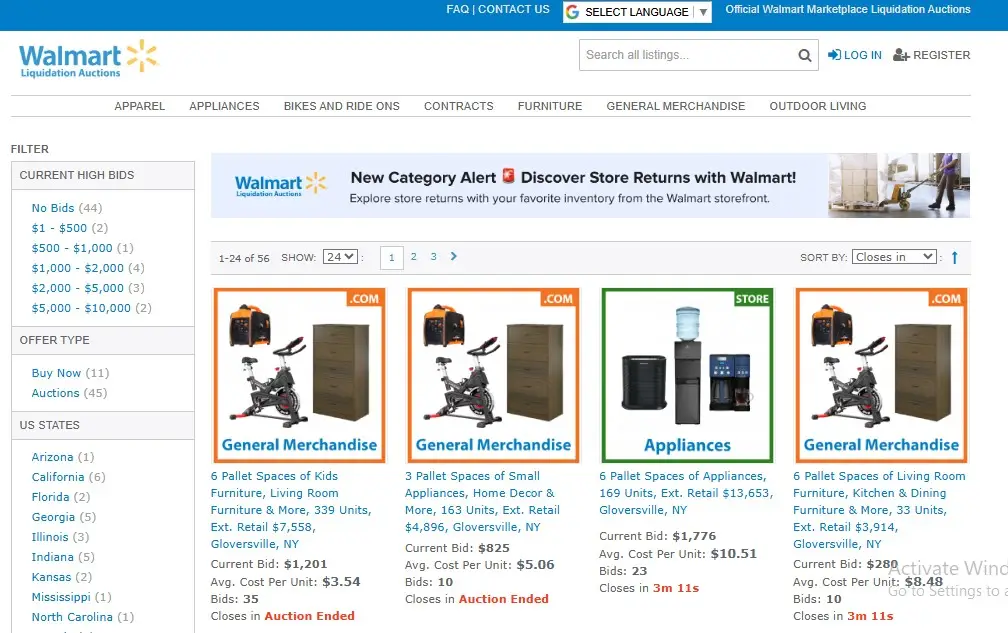
Walmart Liquidation Auctions is the official liquidation marketplace where excess inventory, customer returns, and overstock merchandise from Walmart.com and Walmart stores are sold in bulk directly to approved business buyers. This marketplace is powered by the B‑Stock Sourcing Network, which means that even though the site is branded as Walmart, the underlying auction technology, bidding system, and inventory infrastructure are managed by B‑Stock.
Through this platform, resellers can bid on pallets or full truckloads across almost every product category Walmart sells — from electronics, appliances, and furniture to toys, apparel, and sporting goods. Lots vary in condition, with listings typically including detailed manifests that show item descriptions, UPCs, estimated retail value, and sometimes condition notes. These manifests are crucial because they help buyers assess the potential profitability before placing a bid.
Walmart Liquidation Auctions uses a traditional timed auction format where buyers place proxy bids (a maximum bid the system uses to automatically outbid competitors). If bidding continues right up to the scheduled closing time, a system called “popcorn bidding” extends the auction, giving everyone a fair chance to respond to late bids.
One key advantage of buying from this official source is that there’s no middleman taking a cut — you’re bidding on Walmart’s own inventory directly (via B‑Stock). However, because the merchandise is sold “as is,” you cannot inspect items physically before purchase, and all sales are final. This means experienced resellers invest time reviewing manifests and current bids to make intelligent, data‑driven bidding decisions.
Because Walmart Liquidation Auctions handles thousands of lots weekly, it remains one of the most reliable ways to source pallets for resale profit in 2026 — especially for serious entrepreneurs who treat liquidation as a scalable business rather than a gamble.
B‑Stock Solutions
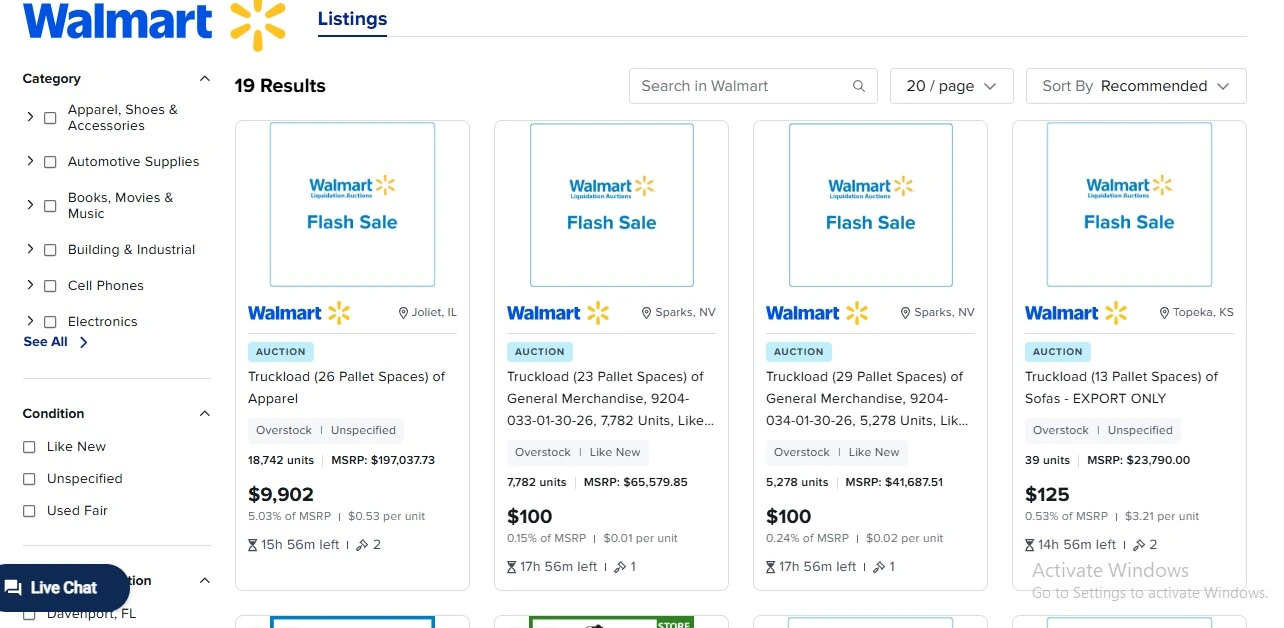
B‑Stock Solutions is not a retailer but the foundation of many official liquidation auction platforms used by the biggest brand names in retail — including Walmart, Target, Amazon, and others. When people bid on or purchase Walmart liquidation pallets through an “official” source, they’re almost always doing so on a B‑Stock‑powered marketplace.
Think of B‑Stock as the backend engine that lets giant corporations turn their excess inventory into transparent, structured auctions that tens of thousands of resellers around the world can access. The site itself hosts dozens of branded storefronts — like Walmart Liquidation Auctions — as well as a central hub where buyers can discover inventory from multiple retailers in one place.
One big advantage of using B‑Stock directly is the breadth of inventory available. Instead of searching multiple standalone sites, resellers can filter pallets by:
Retailer source (Walmart, Target, Amazon, etc.)
Product category (electronics, home goods, apparel, tools)
Condition (new, used, refurbished, salvage)
Lot size (single pallet, LTL, full truckload)
In addition to traditional timed auctions, B‑Stock offers “Buy Now” and net terms options — meaning approved buyers can secure inventory immediately without bidding, and sometimes even pay within 30 days rather than upfront. This makes it particularly beneficial for resellers who want to manage cash flow or scale faster.
Registration on B‑Stock usually requires a business email and resale credentials, but once approved you gain access to a powerful dashboard loaded with analytics, detailed manifests, and auction histories that help inform purchasing decisions.
Because this platform aggregates inventory from many top retailers under one roof, buyers get more choices and better pricing opportunities. It also exposes resellers to truckload options and bulk lots, which are ideal for those looking to scale beyond a few pallets at a time.
For many serious resellers in 2026, B‑Stock is the most efficient way to source quality Walmart liquidation pallets while also exploring liquidation deals from other major retailers — all from one centralized marketplace.
Direct Liquidation
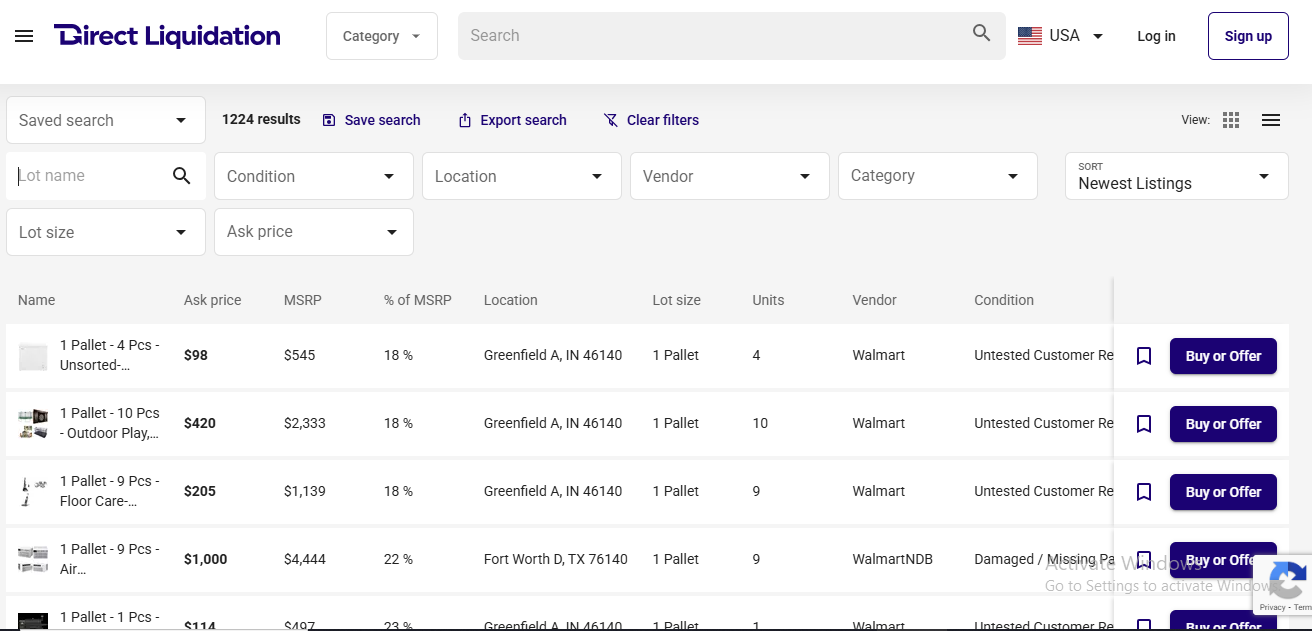
Direct Liquidation is a long‑established wholesale marketplace that connects buyers with liquidation inventory sourced directly from major U.S. retailers — including Walmart, Amazon, Target, and others. Unlike auction‑only platforms, Direct Liquidation offers multiple purchasing paths: bid on pallets, buy now at a fixed price, or negotiate offers on select lots.
The process starts with a straightforward online registration where buyers create an account, provide a valid resale certificate, and browse thousands of inventory listings that get updated multiple times per day. Categories range from customer returns and overstock merchandise to end‑of‑life products, with detailed lot descriptions that help you evaluate potential resale value before purchase.
Direct Liquidation stands out for its price transparency and flexible purchase options. Many listings include not just auction bidding but “Buy It Now” or negotiated offers, allowing resellers to secure inventory at known prices without waiting for an auction to close. This is particularly useful if you’re building predictable monthly resourcing plans or want fast turnaround on inventory acquisition.
Another advantage is the platform’s built‑in freight and logistics support. After selecting a pallet or truckload, you can enter payment and shipping instructions directly through the site, and Direct Liquidation integrates with common freight carriers to streamline delivery. There’s no need to broker freight separately unless you choose to handle shipping on your own.
Direct Liquidation also serves a wide range of business types, from small YouTube resellers and local bin stores to larger ecommerce shops selling on Amazon, eBay, or Shopify. Because its inventory includes a mix of wholesale returns and quality overstock, many resellers appreciate that they can find category‑specific lots (like electronics or seasonal items) that match their niche without dealing with completely random mixes.
This dual auction + fixed‑price model combined with robust inventory data makes Direct Liquidation a strong choice for buyers who want a bit more control over pricing, payment timing, and logistics compared to traditional auction‑only platforms.
Select Liquidation
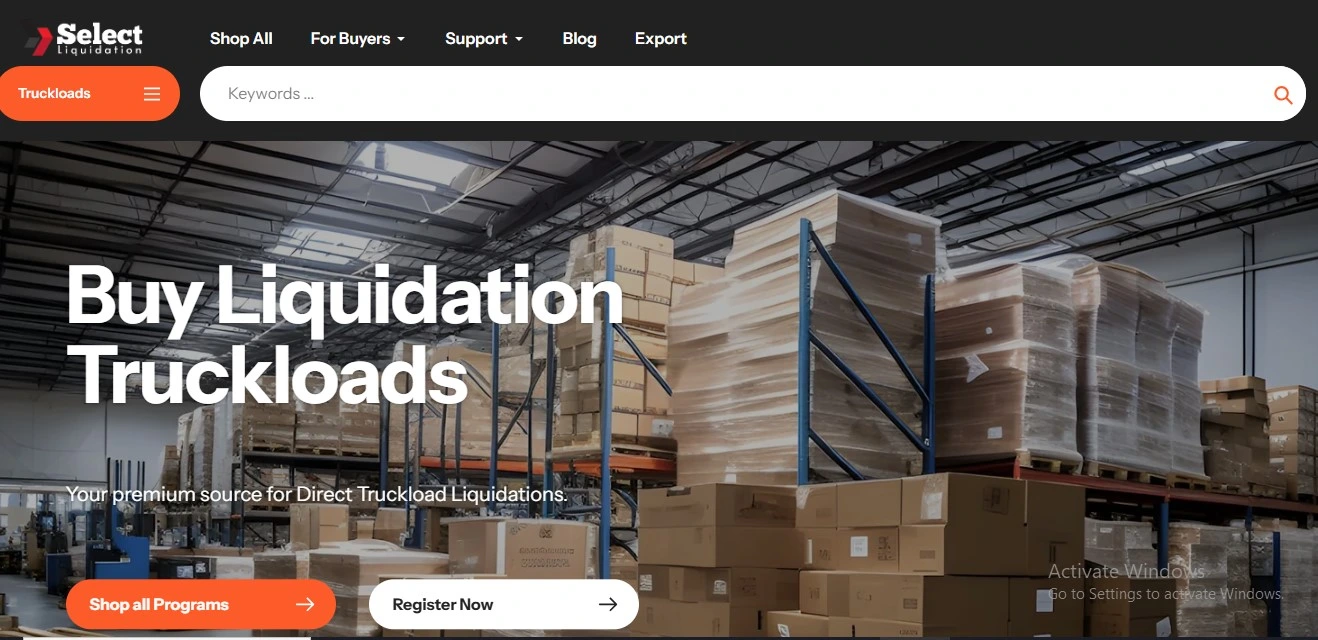
Select Liquidation is a U.S.‑based liquidation wholesaler that specializes in direct truckloads and pallets of returned, overstock, and clearance merchandise from major retailers — including Walmart, Amazon, Target, Home Depot, and others. What sets Select Liquidation apart in 2026 is its structured approach to wholesale inventory, focusing on organized truckloads, regional distribution, and dedicated sales support rather than purely auction‑style bidding.
Through Select Liquidation’s platform, resellers can access large pallet programs and truckloads that contain a mix of general merchandise, appliances, consumer electronics, sporting goods, home improvement items, apparel, and more. Each truckload typically contains 24–26 pallets, offering a higher volume, lower per‑unit cost sourcing solution compared with buying individual pallets one at a time.
Unlike auction‑only sites, Select Liquidation places a strong emphasis on sales support and buyer relationships. After registration, you’re typically assigned a sales representative who helps guide you through inventory programs, order placement, freight arrangements, and delivery logistics — making it easier to manage large orders without guesswork.
Most of the warehouse disposal loads originate from retailer distribution centers across the U.S., including states like Indiana, South Carolina, Georgia, and Texas. These large truckloads include items shipped directly from the retailer, meaning you’re not buying leftover scraps from a third party but bulk pallets packed at the source.
Select Liquidation is particularly appealing to resellers who want predictable inventory streams and category‑specific options. Rather than sifting through random mixes, you can choose pallets (or truckloads) focused on categories like electronics, home goods, bedding, or seasonal products — which helps reduce sorting time and improve resale consistency.
Because the inventory is organized and large in quantity, this source is ideal for established resellers with storage capacity and logistics plans, but it’s equally viable for smaller businesses starting to scale beyond single pallets. With clear manifests, freight coordination support, and a professional customer service model, Select Liquidation brings a wholesale‑level approach to buying Walmart liquidation inventory.

An overview of the Walmart Spark Review Program, including how it works and why it matters for sellers.
How Much Do Walmart Liquidation Pallets Cost in 2026?
Let’s talk numbers, because this is where warehouse reality meets reseller strategy.
In 2026, Walmart liquidation pallets typically cost anywhere from $200 to $1,000 per pallet, with high-value lots — packed with electronics, power tools, or branded home goods — reaching $2,900. For resellers looking to scale, full truckload purchases (usually 24–26 pallets) can run $10,000 to $50,000, depending on contents, condition grades, and estimated retail values.
But here’s the crucial insight: sticker price is only part of the equation. What really matters is your actual cost per item and the realistic resale potential.
Take Jordan, a reseller who has been buying Walmart pallets since 2016. Jordan often purchases $600 mystery pallets, which consistently return a profit even after discarding damaged items. According to Jordan, Walmart pallets tend to be more reliable than other retailer liquidation sources: fewer $15 filler items, more $40+ products, and generally higher-value goods that sell faster and recover costs more efficiently.
Here’s a breakdown of typical pallets and returns in 2026:
Walmart Clothing Pallets: Around $250–$275 for 250 pieces, averaging about $1 per item. When sold via flea markets, local bin stores, or small online marketplaces, these pallets typically triple the initial investment, generating $750–$900 revenue.
Walmart General Merchandise Pallets: Costing $500–$800, these lots include tools, home improvement items, electronics, and small appliances. Instead of low-value items, they often contain $40+ products, delivering a common 2× ROI within one to two weeks.
High-End Specialty Pallets: These curated pallets cost $300–$550 and focus on specific categories like electronics, branded tools, or home goods. They are ideal for local sales on Facebook Marketplace, where buyers pay for convenience and immediate availability.
Mixed Mystery Pallets: Priced around $600–$700 for a standard five-foot-high pallet, these lots include a mix of returns and overstock. Even after removing defective or unsellable items, resellers report profitable margins, especially when they prioritize high-value products first.
The key takeaway from top resellers: don’t fixate on pallet cost alone. Instead, calculate based on estimated retail value minus purchase price and shipping. For example, a pallet with a $5,000 estimated retail value, acquired for $800 all-in, can yield excellent profit if approximately 60% of items resell at 50–75% of retail value.
In short, understanding cost per item, realistic resale, and product mix is what separates successful Walmart pallet resellers from those who struggle. The smartest buyers treat liquidation as a data-driven business, not a lottery — carefully selecting pallets that balance purchase price, shipping, and resale potential.
An in-depth look at Walmart Online Pickup and Delivery program and how sellers can benefit in 2026.
How Resellers Actually Make Money Selling Walmart Liquidation Pallets
The Bin Store Model (Volume Over Value)
Bin stores have surged in popularity since 2023, offering resellers a physical retail model that moves huge volumes without individually listing every item.
How It Works: Items are placed in large bins at flat pricing, which drops over the week. Fresh stock might start at $10–$12 per item and gradually drop to $1 for clearance.
The Math: A pallet with 1,000 items costing $1 each can generate steady profits across multiple price points. On clearance day, slow-moving inventory breaks even while making space for the next shipment.
Take Retail Depot in Midland, Texas, for example. Owner Lisa Hernandez started after scoring deep discounts during her own holiday shopping. Her store sources pallets from Walmart, Target, and Macy’s. On “$2 Wednesday,” customers have scored items like blenders or small appliances originally selling for $40–$60 retail.
Bin stores don’t need fancy displays — simple shelving and bins suffice. The “treasure hunt” experience is what drives customer traffic and repeat visits.
Facebook Marketplace & Local Facebook Groups
Facebook Marketplace remains one of the most active resale hubs for Walmart liquidation items, particularly for larger items that are difficult to ship.
Local Pickup Advantage: Sellers avoid shipping fees and can move items faster.
Community Insights: Facebook pallet groups allow resellers to share pricing strategies, track hot pallets, and find bulk buyers for slower-moving items.
Take Jordan and Mia, a couple featured on a pallet-flipping YouTube channel. They resell $50–$100 items through Facebook Marketplace, offering porch pickup and accepting Venmo or cash. Their strategy: fewer, higher-value sales for faster ROI.
eBay for High-Value or Niche Items
For electronics, collectibles, or specialty tools, eBay is unmatched:
Why It Works: Access to buyers outside your local market reduces competition.
Seller Protections: The platform ensures secure transactions and trust.
Pricing Premium: Collectors and enthusiasts often pay significantly more than local buyers.
Example: Sam Patel lists refurbished power tools from Walmart pallets and regularly earns 2–3× the pallet cost thanks to eBay’s national reach.
Live Auction Platforms (Whatnot & Beyond)
Live auction platforms like Whatnot are emerging as a dynamic channel for mixed pallets.
Sellers livestream items, creating urgency with countdown timers and real-time bidding.
Particularly effective for mixed lots with entertainment value, allowing resellers to fetch higher prices than static listings.
Offline Channels: Flea Markets, Swap Meets, and Local Liquidation Events
Never underestimate in-person sales. Flea markets, swap meets, and local events are ideal for:
Clothing, household items, and mid-tier electronics.
Quick volume sales without shipping hassles.
Negotiation opportunities to maximize margins.
Chris, a long-time reseller, reports that clothing pallets bought for $250 often triple in value at local flea markets or discount stores. The in-person format allows buyers to inspect items, boosting sales velocity.
Learn what Walmart Rollback pricing means, how it works, and how sellers can use it strategically.
Common Pitfalls That Destroy Profits in Walmart Liquidation
Buying Through Other Resellers Instead of Official Sources
One of the biggest mistakes is purchasing pallets from other resellers on Facebook Marketplace, Craigslist, or random websites.
By the time a pallet passes through multiple resellers, the best items are already cherry-picked, leaving mostly low-value or damaged products. Margins shrink, and the investment often doesn’t make financial sense.
Pro Tip: Buy directly from verified platforms like Walmart Liquidation Auctions (B-Stock), Direct Liquidation, or Select Liquidation to get first access to unsorted merchandise and maximize profitability.
Ignoring Shipping and Freight Costs
A cheap pallet doesn’t guarantee a profit if shipping eats your margin. Many beginners overlook freight, which can run $50–$500 per pallet, depending on location and volume.
Pro Tip: Always factor shipping into ROI calculations. If you’re near a liquidation warehouse, consider picking up pallets yourself to save on freight costs.
Not Specializing in Product Categories
Trying to sell every type of product rarely works. Generalists often struggle with slow-moving inventory and inconsistent pricing.
Pro Tip: Specialize in categories you understand — electronics, tools, athletic apparel, or home goods. Expertise helps with pricing accuracy, faster turnover, and better customer trust.
Example: Resellers with knowledge of consumer electronics can quickly spot high-value items like headphones, kitchen gadgets, or gaming accessories that sell at premium margins.
Starting Too Big or Too Small
Both extremes are risky:
Too Small: Shipping and handling costs dominate your profit. Testing multiple channels is limited.
Too Big: Buying a full truckload without experience can burn thousands of dollars before you understand local demand.
Pro Tip: Start with 1–3 pallets or a half truckload, depending on budget and storage space. Test the market, learn the process, then scale once you see consistent profits.
Skipping Inventory Evaluation and Sorting
Some beginners assume all items are sellable, leading to wasted time and lost money. About 30–40% of return pallets may include broken or incomplete products.
Pro Tip: Sort, test, and clean items immediately. Track what sells fastest and focus efforts on the most profitable products.
Relying on a Single Sales Channel
Selling everything through one platform limits reach and slows turnover. Local competition or slow online traffic can stall profits.
Pro Tip: Diversify channels:
Facebook Marketplace for local, quick sales
eBay for higher-value, niche items
Bin stores or flea markets for volume clearance
Live auction platforms like Whatnot for mixed lots
A step-by-step guide to creating and optimizing your Walmart Seller Center account for success in 2026.
Final Thoughts: Walmart Liquidation Pallets
Walmart liquidation pallets offer an incredible opportunity to turn returned and overstock merchandise into a profitable reselling business — but success doesn’t happen by accident. The key lies in strategic sourcing, careful evaluation, and smart selling.
Whether you’re looking to generate side income or build a full-scale resale operation, following disciplined strategies can turn Walmart return pallets into a scalable, sustainable business. With preparation, research, and the right mindset, the pallets you buy today could be the foundation for consistent profit in 2026 and beyond.
Contact Us for Tailored Solutions – TechEcomm:
Ready to transform your eBay store and achieve big wins? Contact us at TechEcomm for personalized solutions that leverage the power of automation for your business. Reach out to us at (302) 216-4540 or via email at info@techecomm.com. Sign up and Embark on the path to e-commerce success with TechEcomm – where small changes lead to big wins!


