Amazon SEO: How the A9/A10 Algorithm Works with Ranking Factors and Strategies (2026)

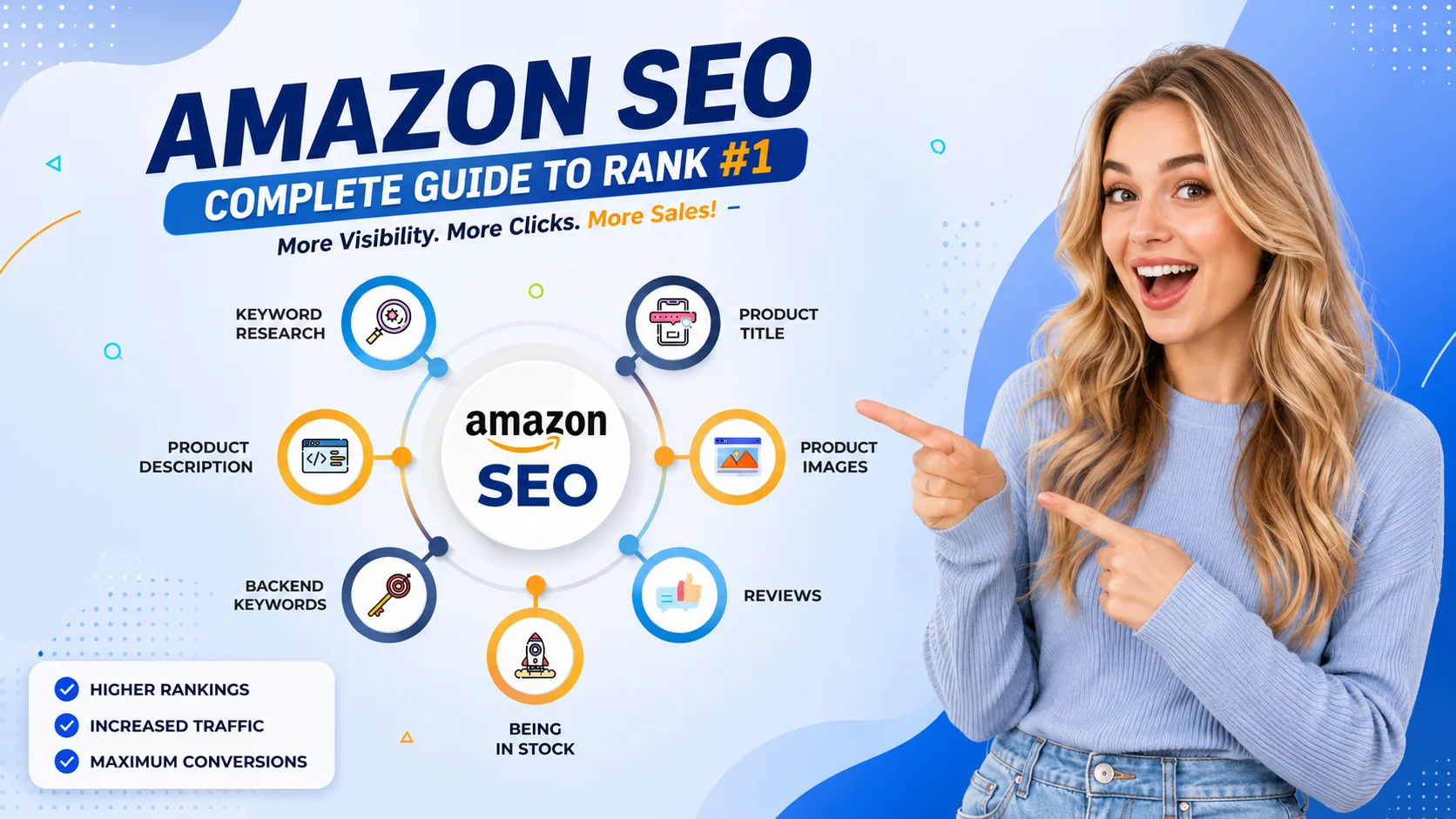
Amazon SEO is optimizing product listings so Amazon's algorithm shows them to more buyers. The algorithm (A9/A10) ranks based on conversion rate, sales velocity, keyword relevance, reviews, and seller authority. In 2026, two AI layers — COSMO and Rufus — now process over 20% of all Amazon searches using semantic intent, not just keyword matching. Rankings can shift within 24 hours of listing changes.
Key Takeaways
- Amazon's algorithm is technically still A9, but the seller community calls it A10 because the ranking priorities shifted so dramatically — conversion rate and seller authority now outweigh keyword density.
- COSMO and Rufus are Amazon's AI layers that process natural language queries — Rufus alone handles over 20% of all Amazon searches as of 2026.
- Amazon deprecated Alt Text as a ranking signal in 2024–2025 and now uses its own computer vision models (Amazon Rekognition) to read product images — stuffing keywords into Alt Text no longer works.
- COSMO's knowledge graph takes 7–14 days to fully update after listing changes; sellers who revert optimization changes after 3 days because "nothing happened" are making a costly timing mistake.
- Low-converting PPC campaigns now feed negative signals back into organic ranking assessments — a failing ad campaign is not just wasting budget, it may actively harm your organic position.
- Rufus users convert at a 60% higher rate than non-Rufus users, making Rufus-optimized listings a direct revenue driver, not just a visibility play.
- The Brand Referral Bonus offers up to 10% rebate on external traffic sales — one of the most underutilized economic advantages available to Amazon sellers in 2026.
Table of Contents
- What Is Amazon SEO and Why Does It Matter?
- What Is the Difference Between Amazon's A9 and A10 Algorithm?
- What Are COSMO and Rufus — and How Do They Change Amazon SEO?
- What Are Amazon's Core Ranking Factors in 2026?
- How Do You Do Amazon Keyword Research Correctly?
- How Do You Optimize Your Amazon Product Title?
- How Do Bullet Points and Descriptions Affect Amazon Rankings?
- How Do Product Images Impact Amazon SEO?
- What Are Backend Keywords and Do They Still Matter?
- How Do Reviews and Conversion Rate Affect Amazon SEO?
- Does External Traffic Actually Help Amazon Rankings?
- How Do Amazon PPC Ads and Organic Rankings Interact?
- How Is Amazon SEO Different From Google SEO?
- Frequently Asked Questions
Amazon SEO is the practice of optimizing your product listings so Amazon's search algorithm surfaces them to more buyers — and the gap between getting it right and getting it wrong is the difference between page one and page five. On a platform where Amazon commands nearly 40% of all US eCommerce sales, your organic search position is the single most valuable real estate in online retail.
Here is what most Amazon SEO guides get wrong: they treat the algorithm like it is still 2021. The ranking system that determined whether your product appeared on page one was simpler then — stuff your title with keywords, drive PPC sales, collect reviews. That formula still partially works, but it is increasingly incomplete. Amazon's search infrastructure in 2026 runs three layers simultaneously — the core A9/A10 relevance engine, the COSMO AI semantic knowledge graph, and the Rufus conversational AI assistant — and each one has different timing, different signals, and different optimization requirements.
This guide covers all three layers with precision: what each one responds to, what the real tradeoffs are, and what most sellers are still doing wrong in 2026. The goal is not to give you a generic checklist — it is to give you a deep enough understanding of how the algorithm works that you can make smart decisions for your specific products and categories.
Figure 1: Amazon's search system runs three layers simultaneously in 2026 — each with different signals and timing.
What Is Amazon SEO and Why Does It Matter?
Amazon SEO is the process of optimizing your product listings — titles, bullet points, images, backend keywords, pricing, and fulfillment setup — to rank higher in Amazon's search results for relevant buyer queries. It is the primary driver of organic traffic to your listings and the foundation of sustainable Amazon sales growth.
Why it matters more than any other single lever: the vast majority of Amazon buyers never go past page one. Over 70% of Amazon shoppers never click past the first page of results, and products in the top three positions capture the overwhelming majority of clicks. If your listing is not on page one for its primary keywords, it is effectively invisible to most potential buyers — regardless of how good the product, pricing, or reviews are.
How Is Amazon SEO Different From Google SEO?
Amazon SEO and Google SEO share surface similarities — both involve keyword optimization and content quality — but they operate on fundamentally different principles. Google's primary goal is to rank the most authoritative, useful content for a query. Amazon's primary goal is to rank the product most likely to be purchased.
| Factor | Amazon SEO (A10) | Google SEO |
|---|---|---|
| Primary signal | Conversion rate + sales velocity | Backlinks + content authority |
| Query intent | Almost entirely transactional | Informational + transactional |
| Time to results | 24 hours to a few weeks | Months to years |
| Content format | Title, bullets, images, attributes | Articles, pages, structured content |
| AI layers | COSMO + Rufus (2025–2026) | Google MUM, SGE, Gemini |
| External signals | External traffic that converts on Amazon | Backlinks, mentions, brand signals |
| Reviews | Direct ranking factor | Indirect trust signal |
The most important practical implication: optimizing for Amazon SEO requires thinking like a buyer at the point of purchase, not like a content strategist. Every word in your listing should serve the goal of making the buyer click "Add to Cart."
Want Your Amazon Listings Fully Optimized and Managed by Experts?
TechEcomm's Amazon FBA automation services handle listing optimization, keyword research, A+ Content, pricing strategy, and ongoing store management — so your products rank and sell without you running it manually.
What Is the Difference Between Amazon's A9 and A10 Algorithm?
A9 and A10 are the same underlying Amazon search system — Amazon never officially released an "A10." The A10 label is seller community shorthand for the major shift in ranking priorities that happened between 2022 and 2025, when Amazon substantially rebuilt its ranking logic around AI, contextual search, and customer satisfaction signals.
Understanding what actually changed helps you understand where to invest your optimization effort:
Figure 2: How Amazon's ranking priorities shifted from raw sales volume to conversion quality and AI-driven intent matching.
| Factor | A9 (pre-2022) | A10 (2022–2026) |
|---|---|---|
| Primary driver | Sales velocity — sell more, rank higher | Conversion quality + customer satisfaction |
| PPC impact | PPC-driven sales boosted organic ranking strongly | PPC conversion rate feeds organic; poor PPC hurts ranking |
| External traffic | Minimal consideration | High-converting external traffic actively rewarded |
| Keyword matching | Exact and phrase match primary | Semantic intent matching via COSMO layer |
| Seller authority | Limited weight | Direct ranking factor — account health, feedback, history |
| Return rate | Minimal signal | High return rate actively suppresses ranking |
| AI integration | None | COSMO (semantic graph) + Rufus (conversational AI) |
| Image analysis | Relied on seller-submitted Alt Text | Computer vision reads images directly; Alt Text deprecated |
The most important practical shift: under A9, you could brute-force rankings with PPC spend and keyword density. Under A10, that approach is not only less effective — poorly managed PPC can actively drag down your organic position. The algorithm now reads quality signals, not just quantity signals.
What Are COSMO and Rufus — and How Do They Change Amazon SEO?
COSMO and Rufus are two AI systems Amazon layered on top of its core search algorithm in 2025 — and together they are the most significant change to Amazon SEO since the A9-to-A10 transition. Most sellers have heard of them but do not understand how they actually work or what specific listing changes they respond to.
What Is COSMO and What Does It Do?
COSMO stands for Common Sense Knowledge Generation. It is Amazon's AI framework, based on large language models, that builds a semantic knowledge graph connecting products to use cases, buyer intent, and contextual relationships. You can read the original Amazon Science paper on COSMO to understand the architecture.
Here is what it means practically: before COSMO, if a buyer searched "gift for dad who likes grilling," Amazon returned listings that contained those exact words. With COSMO, Amazon understands that grilling connects to BBQ tool sets, outdoor cooking accessories, and grill covers — even if your product listing never mentions "gift for dad." COSMO maps your product to its real-world use cases and surfaces it for relevant intent-based queries your title never explicitly targeted.
The optimization implication: your listing needs to clearly communicate what the product does, who it is for, and what problems it solves — not just what category it belongs to. Feature descriptions that tell a story about use cases perform better under COSMO than pure spec lists.
COSMO's knowledge graph takes 7–14 days to fully update after you change a listing, compared to A10's keyword algorithm which reflects changes within 24 hours. Sellers who update their listings and then revert the changes after three days because "nothing happened" are making a timing mistake that costs them the full benefit of the optimization. Give COSMO at least 10 days before evaluating whether a listing change worked.
What Is Rufus and How Does It Affect My Amazon SEO Strategy?
Rufus is Amazon's conversational AI shopping assistant, available in the Amazon app and on desktop since 2024. As of 2026, Rufus processes over 20% of all Amazon searches — one in five buyer queries now goes through an AI system that answers questions and recommends products based on conversational intent rather than keyword matching.
Rufus reads your entire listing — title, bullet points, description, customer reviews, Q&A section — to decide whether to recommend your product and how to describe it to shoppers. Critically, Rufus users convert at a 60% higher rate than non-Rufus users, according to 2026 listing optimization analysis by Incrementum Digital. A Rufus recommendation is not just a visibility event — it is a high-probability purchase trigger.
What Rufus rewards in your listing:
- Natural language that explains the product's purpose, not just its specs
- Clear answers to common buyer questions embedded in your description and Q&A section
- Review content that confirms real-world use cases and buyer satisfaction
- Structured product attributes that match the type of questions buyers ask ("Is this waterproof?", "What size fits a queen bed?")
What Are Amazon's Core Ranking Factors in 2026?
Amazon's ranking factors in 2026 fall into three groups: relevance signals (does this listing match the query?), performance signals (does this listing convert browsers to buyers?), and satisfaction signals (does this product deliver on what the listing promised?).
Relevance Signals
- Title keywords: The most heavily weighted content field for keyword relevance matching. Primary keywords should appear early in the title.
- Bullet point keywords: Secondary keyword placement. The algorithm indexes these after the title.
- Backend search terms: Still active, though their weight has decreased as COSMO's semantic understanding has improved. Useful for synonyms and alternate spellings.
- Product attributes (Item Specifics): Increasingly important under COSMO. Missing attributes mean your product does not appear in filtered or conversational searches even if the title is perfect.
- Category and subcategory assignment: Correct categorization determines which search filters and browse nodes your product appears in.
Performance Signals
- Conversion rate: The most heavily weighted single ranking factor. High conversion rate signals that buyers find your listing relevant and compelling. A 1% improvement in conversion rate has a measurable impact on ranking position in competitive categories.
- Click-through rate (CTR): How often buyers click your listing from search results. High CTR signals that your main image and title are compelling relative to competitors.
- Sales velocity: The rate of cumulative sales over recent time periods. Consistent selling outperforms irregular high-volume spikes in ranking stability.
- FBA fulfillment: FBA listings consistently rank above merchant-fulfilled listings because they align with Amazon's Prime delivery standards and typically produce higher conversion rates.
Satisfaction Signals
- Review rating and count: Both rating average and review volume are direct ranking inputs. Trading cards, for example, saw double-digit review engagement growth for nine consecutive quarters through 2025.
- Return rate: A high return rate is a significant negative signal. It tells the algorithm that your listing is misleading buyers — and Amazon deprioritizes listings that generate buyer dissatisfaction.
- Seller account health: Late shipment rate, cancellation rate, and customer service metrics all feed into seller authority scores that influence ranking. A poor account health score suppresses your entire catalog's visibility, not just individual listings.
- Inventory availability: Stockouts immediately drop your ranking. Amazon does not rank products it cannot fulfill, and recovery from a stockout-driven ranking drop typically takes 2–4 weeks of consistent sales velocity to rebuild.
For sellers building a long-term Amazon presence, understanding the difference between 1P vs 3P Amazon selling models is important context — the ranking signals available to you and how the algorithm treats your account differs meaningfully between the two structures.
How Do You Do Amazon Keyword Research Correctly?
Amazon keyword research means identifying the specific search terms your target buyers use when they are ready to purchase — not when they are researching. Every keyword decision should start with buyer intent verification, not just search volume.
What Tools Work Best for Amazon Keyword Research in 2026?
- Amazon's own autocomplete: Type your primary product term in Amazon's search bar. The dropdown shows real buyer queries ranked by search volume. This is the most Amazon-native data source available for free.
- Helium 10 (Cerebro and Magnet): The industry standard for reverse ASIN lookup (seeing what keywords competitors rank for) and keyword discovery. Cerebro's reverse ASIN feature is particularly valuable for identifying competitor keyword gaps.
- Jungle Scout Keyword Scout: Strong for category-level keyword mapping and historical trend data. Useful for identifying seasonal keyword patterns in your category.
- Amazon Brand Analytics (if you have Brand Registry): Shows actual search frequency ranks for any keyword — real Amazon data, not third-party estimates. The most accurate source available for registered brands.
How Do You Choose Which Keywords to Target?
Here is a framework most sellers skip: target 3–5 high-volume primary keywords in your title, 10–15 secondary terms in your bullets and description, and 20–30 long-tail or variant terms in backend search fields. The mistake most sellers make is going too broad — targeting "coffee maker" when "compact pour-over coffee maker for travel" is the term buyers in their category actually convert on.
Assess buyer intent before committing to any keyword: "best yoga mat" signals high purchase intent; "yoga mat benefits" signals research intent. You want transactional keywords in your main content fields and can accommodate informational terms in your description where they read naturally.
Using Amazon repricer tools alongside your keyword strategy closes another gap: pricing competitiveness is a direct ranking signal, and repricing tools ensure your price stays within the range Amazon considers viable for Buy Box and organic ranking purposes.
How Do You Optimize Your Amazon Product Title?
Your product title is the single highest-weight content element in Amazon's ranking algorithm — it is the first field the A10 system indexes and the first thing both COSMO and Rufus read to understand what your product is.
What Is the Ideal Amazon Title Format?
Amazon's recommended format is: Brand + Product Type + Key Feature + Size/Quantity + Color/Variant. Primary keywords should front-load — appearing in the first 40–60 characters — because both the algorithm and mobile shoppers give the heaviest weight to the beginning of the title.
Over 67% of Amazon traffic now comes from mobile devices, according to eCommerce device usage data from 2026. On a mobile screen, Amazon typically displays only the first 80–100 characters of your title before truncating. If your most important keyword is in character position 120, most mobile buyers never see it — and the algorithm weights early placement more heavily for this reason.
| Title Quality | Example | What It Does Wrong / Right |
|---|---|---|
| ✗ Keyword stuffed | "Running Shoes Men Athletic Shoes Men Running Sneakers Mens Shoes Running Walking" | Penalized by COSMO for unnatural language; poor CTR on mobile; no brand trust |
| ✗ Too vague | "Athletic Shoes Black Size 10" | Missing brand, key features, and buyer-intent terms; ranks for almost nothing |
| ✓ Optimized | "BRANDNAME Men's Lightweight Running Shoes — Breathable Mesh Athletic Sneakers for Gym & Walking, Sizes 7–14" | Brand first, natural language, primary keywords front-loaded, specific and readable |
What Should You Never Include in an Amazon Title?
- Promotional language: "Best," "Amazing," "#1" — Amazon's content guidelines prohibit these and they get algorithmically filtered
- Competitor brand names: Policy violation and grounds for listing suppression
- Pricing or availability information: "Only 5 left!" belongs nowhere in a title
- Subjective claims without data: "High Quality" tells the algorithm nothing useful
How Do Bullet Points and Descriptions Affect Amazon Rankings?
Bullet points are your secondary keyword field and your primary conversion tool simultaneously. They do two jobs at once: tell the algorithm what your product is, and persuade the buyer to click "Add to Cart."
What Makes a High-Converting Amazon Bullet Point?
Lead every bullet with a benefit, then support it with the feature that delivers it. The common mistake is leading with the feature: "12,000mAh battery capacity" is a feature. "Charge your iPhone fully 3 times before needing a recharge — enough power for a full weekend trip" is the benefit that feature delivers. Buyers buy benefits. Features justify the decision after the fact.
- Use all five bullet point slots — empty slots are wasted keyword and conversion real estate
- Front-load each bullet with the key benefit in capital letters:
FAST CHARGING — charge your device to 80% in just 45 minutes... - Include secondary keywords naturally within bullet text — not forced, but integrated where they read genuinely
- Address the most common buyer questions and objections in your bullets — this also feeds Rufus's Q&A understanding of your product
Does the Amazon Product Description Still Matter for SEO?
For brand-registered sellers, A+ Content replaces the standard description — and A+ Content does not directly index for keyword ranking in A10. However, A+ Content significantly improves conversion rates, which feeds directly back into ranking. For sellers without Amazon Brand Registry, the standard description is indexed for keywords and should be written to cover terms that your title and bullets could not accommodate naturally.
The description is also the primary source Rufus draws from for longer explanatory answers about your product. A thin or duplicate description means Rufus has less material to work with when recommending your product in conversational searches.
How Do Product Images Impact Amazon SEO?
Images are an indirect but measurable ranking factor — high-quality images improve click-through rate and conversion rate, both of which feed directly into your ranking position. But in 2026, there is a second, less-understood way images affect your SEO: Amazon Rekognition.
Amazon deprecated Alt Text as a direct ranking signal for the A10 algorithm in 2024–2025. Previously, stuffing keywords into image Alt Text was a common optimization tactic. Amazon now uses its own computer vision models — Amazon Rekognition — to analyze images directly and tag them automatically. Your Alt Text is no longer trusted by the algorithm; the content of the image itself is what the AI reads. This means "Visual Semantics" — what the image actually depicts — is now a real ranking signal. To rank for "running gear," a lifestyle image must clearly show a person in motion, in athletic wear, on a track or road. The algorithm reads the visual context, not the text you label it with.
What Does a Complete Amazon Image Set Look Like?
- Main image: White background, full product visible, no logos or text overlays. This drives your click-through rate from search results — the most important conversion before a buyer even reaches your listing.
- Lifestyle images: Product in realistic use. Helps COSMO and Rufus connect your product to use cases and buyer intent. Be specific — show the context that matches your highest-intent search queries.
- Infographic image: Key specs and features visually highlighted. Converts buyers who skim rather than read.
- Scale/size reference: Eliminates the most common cause of returns — buyers who received an item that was larger or smaller than expected.
- Comparison image: Your product vs. common alternatives or previous versions. Addresses objections without words.
- 360-degree or video: Where available, video significantly increases engagement and session duration — both positive signals for Rufus and Amazon's behavioral algorithm.
What Are Backend Keywords and Do They Still Matter?
Backend keywords are search terms entered in your Seller Central product detail backend that buyers never see but Amazon's algorithm still indexes. They remain useful in 2026, but their relative weight has declined as COSMO's semantic understanding has reduced the importance of explicit keyword matching.
Amazon gives you 250 bytes (not characters — bytes) of backend keyword space per listing. Use this space for:
- Synonyms and alternate spellings your target buyers use but that do not fit naturally in your visible content
- Common misspellings of your brand or product name
- Related terms from adjacent use cases that COSMO connects to your product type
- Regional or colloquial alternatives (UK English vs US English for international sellers)
Want an Expert Team Managing Your Amazon SEO and Store Operations?
TechEcomm's done-for-you Amazon store service covers complete listing optimization, A+ Content creation, keyword strategy, PPC management, and store scaling — handled end-to-end by specialists.
How Do Reviews and Conversion Rate Affect Amazon SEO?
Reviews and conversion rate are the two most powerful performance signals in Amazon's ranking algorithm — and they are the hardest to fake, which is exactly why Amazon weights them so heavily.
Why Does Conversion Rate Matter More Than Sales Volume?
Here is the counterintuitive truth that many Amazon SEO guides miss: a product that generates 100 sales from 200 clicks (50% conversion rate) will rank higher than a product that generates 200 sales from 2,000 clicks (10% conversion rate) — even though the second product sold twice as many units. Amazon interprets high conversion rate as evidence that your listing accurately represents a product buyers want. That is the signal it is trying to amplify.
This means conversion rate optimization — improving your main image, title clarity, price competitiveness, and listing completeness — is often higher-leverage than simply driving more traffic. More traffic to a low-converting listing drives down your conversion rate and can actually hurt your ranking.
How Do Reviews Affect Amazon Ranking?
Reviews influence ranking through two distinct mechanisms: direct algorithmic scoring (review rating and volume are explicit ranking inputs) and indirect conversion influence (buyers convert at dramatically higher rates on listings with 4.0+ star ratings and 50+ reviews). Products enrolled in Amazon Brand Registry gain access to the Vine program, which accelerates review generation for new products through verified purchase reviews from Amazon's trusted reviewer network.
The minimum viable review threshold for most categories: 15–25 reviews puts you in a position to start ranking competitively for long-tail keywords. 50+ reviews unlocks competitive ranking for mid-volume terms. 100+ reviews is required to compete in high-volume primary keyword positions in most established categories.
Does External Traffic Actually Help Amazon Rankings?
Yes — but with a critical qualification that most guides state incorrectly: external traffic only improves your Amazon ranking if it converts at a meaningful rate on Amazon. Volume of external traffic alone does not move the needle. Conversion quality does.
Amazon's algorithm interprets high-converting external traffic as independent market validation — evidence that buyers outside Amazon's own ecosystem are seeking your product. A hundred targeted email subscribers who convert at 15% on your Amazon listing send a stronger ranking signal than ten thousand social media visitors who bounce immediately.
The Brand Referral Bonus makes this economically attractive: Amazon offers up to a 10% rebate on sales driven by tracked external traffic through its Attribution program. This is one of the most underutilized financial advantages in Amazon selling — for a $50 product with a 10% referral bonus, every 100 externally-driven sales effectively returns $500 in fee credits.
The practical external traffic sources worth building in 2026:
- Email list to Amazon: Your own audience is the highest-converting external source. A targeted list of past buyers drives 10–20% conversion rates on Amazon links.
- TikTok and Instagram content: Product demonstrations that link directly to Amazon listings with Attribution tags. Converts better when the content shows the product in genuine use rather than promotional context.
- Google Shopping and Google Ads: Drives discovery-stage buyers to Amazon listings. Lower conversion than email but higher volume potential.
- Influencer partnerships: Particularly effective for categories with strong community followings — fitness, beauty, outdoor gear, home decor.
How Do Amazon PPC Ads and Organic Rankings Interact?
Amazon PPC and organic ranking are more tightly coupled in 2026 than they have ever been — and the relationship cuts both ways. Most sellers know that PPC-driven sales can boost organic ranking. What most guides do not explain is that low-converting PPC campaigns can actively hurt your organic ranking.
Since 2026, Amazon's algorithm uses ad conversion rates as a signal in organic ranking assessments. A PPC campaign that gets clicks but converts poorly — because you are targeting the wrong keywords, because your listing is not optimized for the traffic, or because your bid is generating impressions from non-buyers — sends a negative conversion signal back into the organic algorithm. Your poor-performing PPC is not just wasting budget; it is potentially suppressing your organic position for the same keywords. Before running PPC on a new listing, optimize the listing for conversion first. A listing that cannot convert organic traffic will perform even worse with paid traffic — and now it pays an organic ranking penalty for the privilege.
What Is the Right PPC Strategy for Amazon SEO?
- Optimize listing before launching PPC: Strong title, complete bullets, high-quality main image, competitive price. Driving paid traffic to an unoptimized listing wastes budget and can hurt organic ranking simultaneously.
- Start with Automatic campaigns to discover real buyer search terms: Run automatic targeting for 2–4 weeks before building a manual campaign. The search term report from auto campaigns shows you which queries actually converted — not which ones you assumed would.
- Move winning keywords to exact match manual campaigns: Once you identify converting terms from your auto campaign, create a manual campaign targeting those terms on exact match to control bid costs and isolate the ranking benefit.
- Pause or restructure campaigns with CTR above 0.5% but conversion below 5%: This pattern signals that your listing is attracting clicks but failing to convert — either because of price, images, or content misalignment. Fix the listing before continuing to spend.
Frequently Asked Questions
Amazon SEO in 2026 Rewards Depth, Not Tricks
The sellers winning in Amazon search results in 2026 are not the ones who found a clever hack. They are the ones who built genuinely good listings, achieved consistent conversion rates, maintained healthy seller accounts, and invested in understanding how COSMO and Rufus interpret their products. The algorithm is sophisticated enough now that shortcuts — keyword stuffing, Alt Text manipulation, PPC-to-ranking gaming — do not just fail, they actively backfire.
The good news is that the fundamentals of strong Amazon SEO are entirely achievable. A clear title with front-loaded keywords. Benefit-driven bullet points with natural secondary keyword integration. Lifestyle images that communicate use cases for COSMO. Competitive pricing maintained by a repricer. A proactive review strategy. And enough PPC intelligence to feed organic ranking without dragging it down.
If you want a professional team handling your Amazon SEO, listing optimization, and store operations, TechEcomm's best Amazon FBA automation services build and manage complete Amazon stores — from listing creation and keyword strategy through ongoing optimization and scaling.
Ready to Build a Fully Optimized, Professionally Managed Amazon Store?
TechEcomm's done-for-you Amazon store service handles everything — listing creation, SEO optimization, A+ Content, PPC strategy, and ongoing operations. You own the store. We make it rank.

Amelia Johnson


Amelia Johnson is an E-Commerce Writer at TechEcomm with over 8 years of experience, working since 2018. She creates high-performing online content for small businesses and large enterprises across platforms like Amazon, Walmart, eBay, and Shopify. Amelia blends SEO strategy, marketplace expertise, and compelling storytelling to help brands grow, convert, and compete in fast-paced digital marketplaces.

Amelia Johnson
Amelia Johnson is an E-Commerce Writer at TechEcomm with over 8 years of experience, working since 2018. She creates high-performing online content for small businesses and large enterprises across platforms like Amazon, Walmart, eBay, and Shopify. Amelia blends SEO strategy, marketplace expertise, and compelling storytelling to help brands grow, convert, and compete in fast-paced digital marketplaces.