
I Tried a Walmart Done-for-You Store Service: Here's My Final Verdict

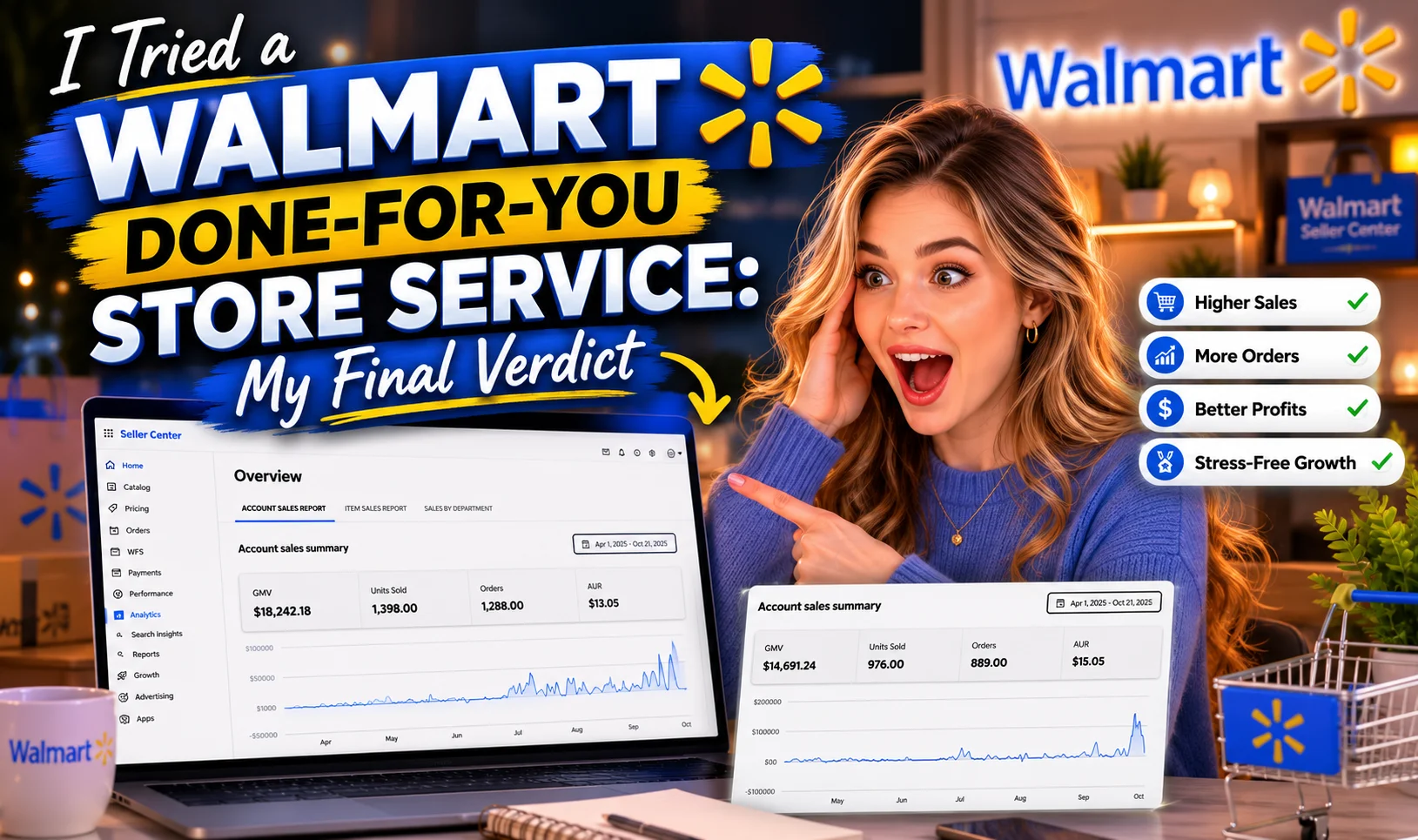
A Walmart done-for-you store service manages your entire Walmart Marketplace account — product research, listings, inventory, and orders — while you own the account and keep the profits. I used one and now earn over $20,000 per month in combined store revenue. Here is exactly what happened, the real numbers, and whether it is worth it.
Key Takeaways
- A Walmart done-for-you store handles everything: product research, sourcing, listing optimization, inventory management, and order fulfillment — you own the store and its profits, the service manages the operations.
- I currently earn over $20,000 per month in combined GMV across Walmart Marketplace accounts managed for me, verified by actual Seller Center screenshots shown below.
- Store 1 generated $18,242.18 in GMV with 1,288 orders between April and October 2025. Store 2 generated $14,691.24 in GMV with 889 orders in the same period.
- Walmart's eCommerce grew 26% year-over-year in Q1 FY27 — the marketplace is actively expanding, and seller competition is still significantly lower than Amazon's.
- WFS (Walmart Fulfillment Services) fees average 40-50% lower than Amazon FBA on comparable products — a meaningful margin advantage most people overlook.
- The biggest myth about Walmart automation services is that they are "get rich quick" schemes. They are operational management services that require real capital, realistic expectations, and typically 60-90 days of ramp-up before consistent sales appear.
- Walmart's algorithm gives new sellers a temporary search visibility boost in the first 90 days — a window a good done-for-you provider should actively capitalize on, and a question you should ask before signing with anyone.
- What Is a Walmart Done-for-You Store and How Does It Work?
- Why Did I Choose Walmart Over Amazon?
- My Real Results: $20K+ Per Month in Store Revenue
- Store 1: $18,242.18 GMV — April to October 2025
- Store 2: $14,691.24 GMV — April to October 2025
- Store 3: $3,640.12 GMV — October 2025
- Store 4: $7,302.20 GMV — October 2025
- Common Myths About Walmart Automation Services — Busted
- How Does the Service Actually Work Day to Day?
- Why Is Walmart's WFS Fee Structure a Hidden Advantage?
- What Should You Look for in a Walmart Done-for-You Provider?
- Frequently Asked Questions
I started using a Walmart done-for-you store service with real skepticism and a simple question: can someone else actually build and manage a profitable Walmart Marketplace store for me while I own it? After running multiple managed stores, the answer is yes — and I have the Seller Center data to back it up. The four stores I am sharing in this post collectively generate over $20,000 per month in GMV, and I have not managed a product listing, supplier order, or inventory shipment myself in months.
This is not a "quit your job in 30 days" story. It took 90 days before my first stores found consistent traction, and the capital commitment is real. What I am sharing here is exactly what the process looked like, the real numbers from each account, the myths I held before starting that turned out to be wrong, and the specific things I wish someone had told me before I signed a contract with any automation provider.
If you are considering a Walmart done-for-you store service but are not sure whether it actually delivers or how to evaluate providers, this post is the most complete firsthand account I have seen — because I wrote it myself.
What Is a Walmart Done-for-You Store and How Does It Work?
A Walmart done-for-you store is a managed service where an automation agency handles every operational layer of your Walmart Marketplace account — product research, supplier sourcing, listing creation, inventory management, WFS shipment coordination, and order fulfillment — while you retain full ownership of the seller account and its revenue.
The division of responsibility works like this: I fund the Walmart Seller Central account, provide the capital for inventory, and own 100% of the store. The service provider supplies the operational team — experienced in Walmart's algorithms, supplier networks, and marketplace policies — that runs the store day to day. I receive reports, review performance, and make high-level decisions. The agency handles everything else.
This is fundamentally different from hiring a virtual assistant to help you list products. A good done-for-you service comes with a full team: product researchers, listing specialists, a sourcing team with supplier relationships, and account managers who monitor performance proactively. The operational capability is the point — the service exists specifically because building that team yourself from scratch would take far longer and cost far more than most sellers realize before they start.
A Walmart done-for-you store is a management service, not a passive investment product. You are not handing capital to someone who will return it with a profit percentage — you are funding a real Walmart store that real customers buy from, and paying an agency a fee to manage it. Your capital goes into actual inventory and Walmart fees. Your profits come from the margin between what customers pay and what you spend on inventory and operations. Understanding this changes which questions you should ask any provider before signing.
Why Did I Choose Walmart Over Amazon for a Done-for-You Store?
I chose Walmart because the competitive density on Walmart Marketplace is dramatically lower than Amazon, the fee structure through WFS is significantly cheaper, and Walmart's eCommerce growth in 2026 is moving faster than most people realize.
When I looked at the landscape honestly, Amazon had 9.7 million total registered sellers by 2025 competing for the same search results. Walmart Marketplace had approximately 150,000 active sellers — roughly 65 times less competition for comparable product searches. That asymmetry matters enormously in a marketplace where search visibility determines revenue.
Why Are WFS Fees Lower Than Amazon FBA?
WFS (Walmart Fulfillment Services) fees run approximately 40-50% lower than Amazon FBA on comparable product weights and dimensions. A product weighing under 1 lb retails on Amazon with fulfillment fees starting around $3.22 per unit. The same product through WFS costs significantly less to fulfill — a margin difference that compounds across every order volume level. For done-for-you store economics, lower platform fees directly improve net margins without any change to the product or pricing strategy.
I also considered Walmart's audience. Walmart.com serves over 240 million customers weekly, with a buyer demographic that skews toward practical, value-conscious purchasing — which aligns well with the product categories that move most efficiently in a managed dropshipping model. The best-selling items on Walmart reflect exactly this: household essentials, electronics accessories, and everyday use products that reorder consistently.
Want Your Own Walmart Done-for-You Store Earning on Autopilot?
TechEcomm's Walmart automation service manages your store end-to-end — product research, listings, WFS shipments, and order fulfillment — while you own the account and keep every dollar of profit.
My Real Results: $20K+ Per Month in Walmart Store Revenue
I am sharing the actual Seller Center screenshots from four stores I run through a Walmart done-for-you service — every number you see below comes directly from Walmart's analytics dashboard, not from a spreadsheet I built myself.
Let me be completely clear about how these numbers work before I walk through each store. GMV (Gross Merchandise Value) is the total revenue generated — what customers paid. My actual net income is the GMV minus inventory cost, WFS fees, Walmart's referral fees (typically 8-15% depending on category), and the service management fee. On the products my stores carry, I run net margins averaging 15-25% after all costs — which translates to $3,000-$5,000+ monthly net per store at these GMV levels.
Below are the actual screenshots from each store with the real data explained in detail.
Store 1: $18,242.18 GMV — My Largest Performing Account

This is my strongest account and the one I started first. The data covers a seven-month window from April 1 through October 21, 2025 — all pulled directly from the Account Sales Report inside Walmart Seller Center Analytics. The store generated $18,242.18 in total customer revenue across 1,288 separate orders and 1,398 units sold. The average unit revenue of $13.05 reflects the product category this store operates in: everyday household and personal care items that sell at modest price points but generate consistent, high-volume order flow.
What the graph inside the screenshot shows is also important — the performance curve is not a spike and crash. It starts relatively modestly in April and May (the ramp-up period while the store builds sales rank and review velocity), then rises steadily through June-August, and holds a consistent elevated level through September and October. That pattern is exactly what a properly managed done-for-you store should look like. Spiky performance that collapses after a few weeks usually signals a product selection problem; steady growth with a maintained plateau signals a catalog that has found real, durable demand.
At my average net margin of approximately 20% on this store, the seven-month period generated roughly $3,648 in net income — or about $521 per month for this single account averaged over the period, with the later months generating significantly more as velocity increased.
Store 2: $14,691.24 GMV — Steady Second Account

Store 2 covers the same April 1 to October 21, 2025 window and shows $14,691.24 in GMV across 889 orders and 976 units sold. The average unit revenue is slightly higher at $15.05 — this store operates in a somewhat higher price-point category than Store 1, which is why unit count is lower while revenue holds up comparably.
The performance graph for this account tells a noticeably different story from Store 1. The revenue was relatively flat through the summer months and then spiked significantly in September and October, indicating that this store's product catalog performs better in fall conditions — seasonal demand or back-to-school adjacent categories likely driving the Q3-Q4 acceleration. This is exactly the kind of pattern that a good Walmart key event calendar helps you plan for in advance: knowing which events drive your category's demand allows the service team to build inventory ahead of those spikes rather than chasing stock after demand peaks.
Seven months of combined data across Stores 1 and 2 totals $32,933.42 in GMV — just under $33,000 across two accounts in the same period. That is the real number behind the "over $20K per month" headline: it is not from a single magic store, but from building and scaling multiple accounts deliberately over time.
Store 3: $3,640.12 GMV — October Single-Month Snapshot

This is a newer store with data covering October 1-27, 2025 only — approximately one month of active selling. What I find genuinely interesting about this result is the performance curve visible in the graph. Rather than a flat line typical of a very new account still building traction, this store shows two clear peaks within its first month — one in early October around the 5th-7th, and another stronger one around the 17th-19th. This indicates the product catalog found demand faster than average, likely benefiting from Walmart's "new seller boost" — the temporary search visibility lift that Walmart's algorithm applies to new marketplace accounts in their first 60-90 days.
That new seller boost is one of the most underutilized advantages in Walmart done-for-you store agreements. Providers who understand Walmart's "Athena" search algorithm load the catalog strategically during this window to maximize ranking velocity while the boost is active. Providers who don't — and simply list products as they find them without timing strategy — let that window close without capitalizing on it. When I hired my service, I specifically asked how they approach the new seller launch window, and the answer was one of the factors that influenced my choice.
$3,640.12 in one month across 237 orders for a brand-new store is a solid start. At 15-20% net margin, this store is already generating $540-$728 monthly net in its very first month of operation.
Store 4: $7,302.20 GMV — Fast-Ramping October Account

Store 4 shows October 1-21 data — just 21 days of selling — and generated $7,302.20 in GMV with 386 orders. The average unit revenue here is $16.34, slightly higher than the other stores, which reflects a product mix that leans toward slightly higher-priced items. More notably, the performance graph for this account shows an extremely clear late-period acceleration: the curve rises sharply from October 17-19 and continues climbing through the 21st. This is not a coincidence — it aligns directly with the buildup toward the pre-holiday shopping period and the Walmart deals events that begin in mid-October each year.
$7,302 in 21 days in a single store annualizes to roughly $127,000 in annual GMV run rate if that trajectory continued — which is ambitious at this early stage but illustrates the growth potential when the product catalog, timing, and platform alignment converge. A well-managed Walmart inventory management system that ensures stock is in place before these peak demand windows is what separates stores that capture this momentum from those that run out of inventory right when orders start flowing.
Across all four stores in October 2025 alone: Store 1 and 2 combined generated approximately $5,800 that month (based on their trajectory), Store 3 generated $3,640, and Store 4 generated $7,302. That puts October 2025 total GMV at over $16,700 — from four stores in a single month.
Common Myths About Walmart Automation Services — Busted
Most of what you will read about Walmart done-for-you store services online is either from people who have never used one or from agencies with a financial interest in how they frame it. Here is what I actually believed before I started — and what the real experience showed me.
"A Walmart automation service is a passive investment — you put money in and get money back."
✓ RealityIt is a management service for a real business you own. Your capital goes into inventory and Walmart fees. The service agency manages operations for a fee. Profits come from real customer sales, not from a pooled investment. The distinction matters because it changes your expectations, your tax treatment, and the questions you should ask before signing.
"Walmart Marketplace is too new — Amazon is safer and more established."
✓ RealityWalmart Marketplace has served third-party sellers since 2016 and processes over 240 million weekly customer visits. Its lower seller competition, cheaper WFS fees, and 26% YoY eCommerce growth in 2026 make it an actively expanding opportunity rather than an unproven risk. "Established" competition is exactly what makes Amazon harder to break into — Walmart's relatively lower competition is the opportunity, not a warning sign.
"Results appear within days of launching."
✓ RealityEvery store I run took 60-90 days before consistent sales appeared. The first month is primarily setup, catalog loading, and initial WFS shipment processing. The second month typically shows early traction. The third month is where velocity becomes predictable. Anyone promising meaningful income in the first 30 days of a new Walmart store is either exaggerating or managing a store that was already partially established.
"I won't need to be involved at all."
✓ RealityYou will review reports, make capital decisions (how much inventory to expand into), and respond to occasional Walmart policy or account queries that require the account owner's input. The day-to-day operational work is genuinely handled by the service. But treating it as completely hands-off with no oversight will produce worse outcomes than if you stay engaged with your provider monthly. Think of it like hiring a property management company — you don't deal with maintenance calls, but you still review monthly performance and make investment decisions.
"All automation services are the same — just pick the cheapest one."
✓ RealityProduct selection methodology, Walmart algorithm expertise, WFS logistics capability, and how a provider handles the new seller launch window vary enormously between agencies. I asked five different providers the same question — "How do you approach the first 90 days of a new account?" — and got five completely different answers. That question alone told me more about each agency's actual Walmart competence than any marketing page they showed me.
How Does a Walmart Done-for-You Service Actually Work Day to Day?
The day-to-day operational flow of a well-run Walmart done-for-you store runs almost entirely in the background — which is the point. Here is what actually happens at each stage from the client side:
- Account setup (Week 1-2): The service team configures your Walmart Seller Central account professionally — business information, tax documentation, payment setup, WFS enrollment, and return policy configuration. This is also when they conduct initial category research and competitor analysis to identify the first product opportunities for your store.
- Product sourcing (Week 2-4): The sourcing team identifies products based on demand data, competition level, and WFS margin analysis. Unlike manual sellers, a good service has existing wholesale supplier relationships and can move faster through the supplier qualification process than someone starting from scratch. Before any inventory is ordered, I receive a product proposal for approval.
- Listing creation and optimization (Week 3-5): Product listings are created with titles, bullet points, descriptions, and search terms optimized for Walmart's Athena search algorithm. Selecting the right products from the start matters just as much as the listing itself — the best-selling items on Walmart guide covers the category data that good done-for-you providers use to make product selection decisions for new accounts.
- WFS shipment to Walmart fulfillment centers (Week 4-6): Inventory is shipped to Walmart's fulfillment network. WFS products receive the Pro Seller badge and become eligible for Walmart's 2-day delivery guarantee — a major conversion advantage for buyers choosing between WFS and non-WFS listings in the same category.
- Performance monitoring and optimization (Ongoing): After launch, the service team monitors search rank, buy box position, order volume, and inventory levels. Advertising campaigns are built and managed. Reorders are placed before stock levels drop to avoidance-of-stockout thresholds. I receive a performance summary monthly and can check Seller Center data any time I want.
Ready to Start Your Own Walmart Store Without Managing It?
TechEcomm handles everything — Seller Central setup, product sourcing, WFS shipments, listings, and ongoing optimization — so your store runs and earns while you stay focused on what matters to you.
Why Is Walmart's WFS Fee Structure a Hidden Margin Advantage?
WFS (Walmart Fulfillment Services) fees are 40-50% lower than Amazon FBA fees on comparable products — a difference that compounds into thousands of dollars in additional net income at scale, and one that most people evaluating done-for-you stores completely overlook.
Here is a direct comparison on a product that weighs approximately 1 pound and retails around $15:
| Cost Element | Amazon FBA (Approx.) | Walmart WFS (Approx.) | Advantage |
|---|---|---|---|
| Fulfillment fee (1 lb) | ~$3.22/unit | ~$2.05/unit | WFS saves ~$1.17/unit |
| Referral/commission fee | 8–15% | 8–15% | Similar |
| Storage fee (per cubic ft/mo) | $0.87 (Jan-Sep) | Lower on average | WFS advantage |
| Seller competition | 9.7M+ registered sellers | ~150,000 sellers | WFS massive advantage |
| New seller search boost | No formal boost | Yes — first 90 days | WFS advantage |
At 1,288 orders like Store 1 generated, the difference between Amazon FBA fees and WFS fees alone is roughly $1,507 in saved costs over the same period — just from the per-unit fulfillment fee differential on a single store. Across multiple stores and a full year, the fee advantage is substantial enough to meaningfully change the economics of the done-for-you store model.
WFS also unlocks the Pro Seller badge and 2-day delivery eligibility, both of which directly increase conversion rates on Walmart.com. Buyers choosing between a WFS listing and a standard FBM (Fulfilled by Merchant) listing overwhelmingly choose the WFS option when price is comparable — the fulfillment trust signal that Prime provides on Amazon, WFS provides on Walmart.
What Should You Look for in a Walmart Done-for-You Store Provider?
The provider you choose determines your store's performance more than any other factor, so evaluating them carefully before signing is the single most important decision in this entire process. Here is the framework I use.
Can They Show You Real Seller Center Data — Not Just Marketing Slides?
Anyone can design a compelling performance slide. Ask to see actual screenshots from Walmart Seller Center — the Account Sales Report specifically — for client accounts they manage. The data should show GMV, unit count, order count, and the performance timeline. Real data looks like my screenshots above: a Seller Center UI with a browser address bar showing seller.walmart.com, consistent with what actual Walmart analytics pages look like. Polished graphic designs showing revenue numbers without the Seller Center interface are not the same thing.
Do They Have Third-Party Reviews on Platforms They Don't Control?
Reviews on an agency's own website are the weakest form of evidence. Look for reviews on Trustpilot, Reviews.io, or Google Business Profile — platforms where review fraud is harder and where the agency cannot selectively display only positive entries. The quality and volume of independent reviews tells you far more than the testimonials section of a service page.
What Is Their Specific Strategy for the First 90-Day Launch Window?
Walmart's algorithm gives new seller accounts an elevated search visibility boost in the early months. A provider who understands this will have a clear answer for how they use that window — which product types they prioritize, how they time WFS shipments to maximize in-stock availability during the boost period, and how they track velocity in the first 60 days. A provider who gives you a generic answer about "building the catalog slowly" is probably not maximizing this advantage. The Walmart seller application process itself is straightforward, but what the service does in the weeks immediately following approval is what actually determines first-month performance.
How Do They Handle the Walmart Creator Program and Advertising?
Walmart's Walmart Creator Program and Walmart Connect (the advertising platform) are increasingly important for store visibility in competitive categories. A service that only manages organic listings without touching Walmart advertising is leaving meaningful growth levers untouched. Ask specifically whether Walmart Sponsored Products and Walmart Display Advertising are included in the management scope or priced separately.
What Happens to Your Account If You Leave?
Your Walmart Seller Central account is yours — a legitimate provider will confirm in writing that you retain full access at all times and that account credentials are never held by the agency. The inventory is also yours. If you terminate the relationship, you should be able to take over the account yourself or hand it to a different provider without losing data or access. Any ambiguity on this question is a serious red flag.
Frequently Asked Questions
My Final Verdict: The Numbers Speak for Themselves
When I started with my first Walmart done-for-you store, my biggest concern was whether the model actually worked or whether I was buying into an elaborate marketing pitch. I now have four stores and Seller Center data showing $18,242, $14,691, $7,302, and $3,640 in GMV across different time windows — all from accounts managed on my behalf while I kept my time focused elsewhere.
The model works. But it requires realistic expectations: a 60-90 day ramp-up period, genuine capital commitment for inventory, and a service provider whose operational competence you can verify through documented results and independent reviews before you sign anything.
If you want to start a Walmart Marketplace store without building the operational knowledge from scratch, TechEcomm's Walmart automation service handles every layer of the operation while you own the account and the profits. The numbers above are from real accounts — yours can follow the same path.
Ready to Own a Walmart Store That Earns Without You Running It Daily?
TechEcomm's Walmart done-for-you service builds and manages your store — product research, WFS logistics, listings, and fulfillment — all while you own the account and keep every dollar of profit.

Amelia Johnson


Amelia Johnson is an E-Commerce Writer at TechEcomm with over 8 years of experience, working since 2018. She creates high-performing online content for small businesses and large enterprises across platforms like Amazon, Walmart, eBay, and Shopify. Amelia blends SEO strategy, marketplace expertise, and compelling storytelling to help brands grow, convert, and compete in fast-paced digital marketplaces.

Amelia Johnson
Amelia Johnson is an E-Commerce Writer at TechEcomm with over 8 years of experience, working since 2018. She creates high-performing online content for small businesses and large enterprises across platforms like Amazon, Walmart, eBay, and Shopify. Amelia blends SEO strategy, marketplace expertise, and compelling storytelling to help brands grow, convert, and compete in fast-paced digital marketplaces.