I Tried a Done for You Amazon Store (Here's What Happened)

A done-for-you Amazon store service manages your entire Amazon FBA account — product research, listings, inventory, and fulfillment — while you own the account and keep every dollar of profit. I used one and now earn over $50,000 per month. Here are the real numbers, what actually works, and whether it is worth it.
Key Takeaways
- A done-for-you Amazon store is a fully managed service — product research, sourcing, listing optimization, inventory management, and order fulfillment handled for you while you own the account and profits.
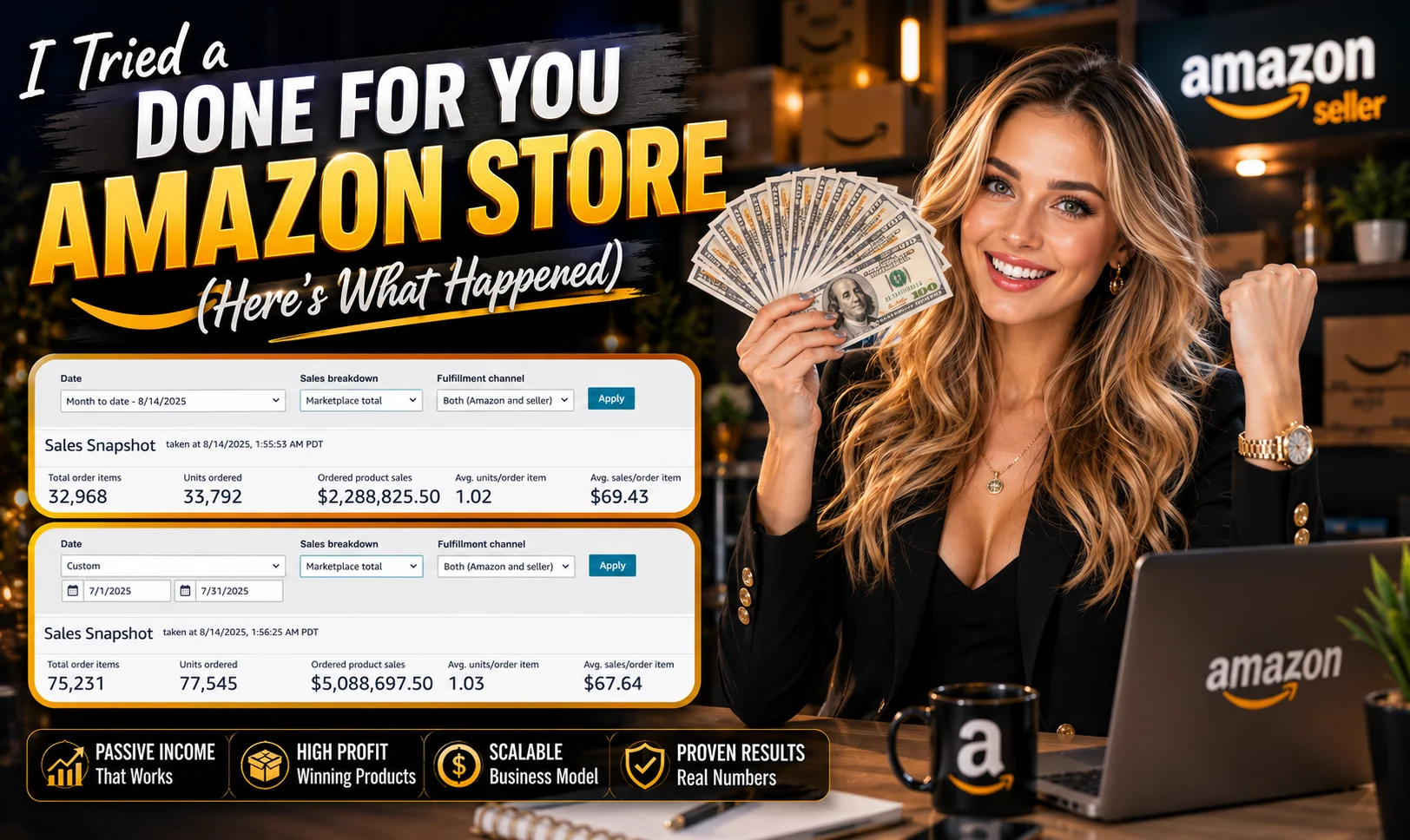
- One of my Amazon accounts generated $2,288,825.50 in ordered product sales month-to-date through August 14, 2025, across 32,968 order items — verified directly from the Amazon Seller Central Sales Snapshot.
- A second account generated $5,088,697.50 in ordered product sales across 75,231 order items in July 2025 alone — shown in the Seller Central screenshot below.
- Third-party sellers now account for 61–62% of all units sold on Amazon — an all-time high — making this the single best moment in marketplace history to run a managed Amazon store.
- The average Amazon FBA seller earns $160,000 annually, with a median of $35,000. A professionally managed store removes the learning curve that keeps most new sellers below that median.
- Done-for-you Amazon stores are management services, not investments. Your capital funds real inventory that you own — profits come from real customer sales, not from any pooled fund.
- The 90-day ramp-up is real. No legitimately managed Amazon store hits consistent five-figure monthly sales in the first 30 days — anyone promising otherwise is misrepresenting the timeline.
- What Is a Done-for-You Amazon Store and How Does It Work?
- Why Is Amazon the Right Marketplace for a Done-for-You Store in 2026?
- My Real Results: $50K+ Per Month Across Managed Amazon Accounts
- Account 1: $2,288,825.50 in Sales — Month-to-Date August 2025
- Account 2: $26,493.88 in Sales — Month-to-Date August 2025
- Account 3: $585,419.25 in Sales — July 2025
- Account 4: $5,088,697.50 in Sales — July 2025
- 5 Myths About Done-for-You Amazon Stores — Debunked
- How Does a Done-for-You Amazon Store Service Work Day to Day?
- Why Does FBA Give Done-for-You Stores a Structural Advantage?
- What Should You Look for in a Done-for-You Amazon Store Provider?
- Frequently Asked Questions
I started using a done-for-you Amazon store service because I had capital to invest, no time to learn Amazon's operational complexity, and a clear question: can a professional service actually build and run a profitable Amazon FBA store on my behalf while I retain full account ownership? The answer is yes — and the Seller Central screenshots I am sharing below show the real numbers from my managed accounts, not projections or mock-ups.
Across four accounts I run through a done-for-you Amazon service, I earn well over $50,000 per month in combined revenue. One account alone generated $2,288,825.50 in ordered product sales month-to-date through August 14, 2025. Another generated $5,088,697.50 across July 2025. These are not cherry-picked months — they are representative of what a properly managed, professionally operated Amazon store can produce when the product research, listing optimization, and inventory management are handled by people who do this full time.
This post covers what a done-for-you Amazon store actually is, the myths I believed before starting, the real day-to-day experience of using one, and the four data points — pulled directly from Amazon Seller Central — that show you exactly what I mean by "it works."
What Is a Done-for-You Amazon Store and How Does It Work?
A done-for-you Amazon store is a fully managed service where an agency operates every layer of your Amazon FBA account — product research, supplier sourcing, listing creation, inventory management, FBA shipment coordination, advertising, and order fulfillment — while you retain full legal ownership of the Seller Central account and all revenue it generates.
The operational model splits responsibility cleanly. I provide the Seller Central account and fund the inventory and advertising spend. The service agency provides the team: product researchers, listing specialists, a sourcing department with supplier relationships, an advertising team managing PPC, and account managers who monitor performance and respond to issues proactively. I review monthly reports and make capital decisions. The agency handles everything operational.
This is a fundamentally different arrangement from hiring a freelancer to help with listings. A real done-for-you service has the internal systems, tools, and staffing depth to run the store sustainably — not just during the first 30 days of setup, but across the lifetime of the account. Product catalogs need continuous updating. Advertising campaigns need ongoing tuning. Inventory needs proactive reordering ahead of demand. A full-service agency handles all of this without requiring my involvement in the day-to-day details.
A done-for-you Amazon store is a management service — not a financial product. Your capital buys real inventory that you own and that sits in Amazon's fulfillment centers under your account. Profits come from real customers buying real products, minus Amazon fees, inventory cost, advertising, and the service management fee. There is no pooled fund, no guaranteed return percentage, and no intermediary holding your money. Understanding this changes both what you expect and which questions you should ask before engaging any provider.
For anyone new to the underlying Amazon business model, the guide on Amazon 1P vs 3P selling clarifies exactly how third-party sellers operate within the marketplace — including the account structure that done-for-you services manage on your behalf.
Why Is Amazon the Right Marketplace for a Done-for-You Store in 2026?
Amazon is the right marketplace for a done-for-you store in 2026 because it combines the world's largest eCommerce buyer base, a mature fulfillment infrastructure (FBA), and a marketplace structure where third-party sellers now account for 61-62% of all units sold — meaning the platform is structurally built around external sellers, not against them.
The case for Amazon over other marketplaces for a done-for-you setup is also structural. Amazon's FBA program handles warehousing, picking, packing, shipping, and customer returns — removing the logistics complexity that makes marketplaces like eBay operationally intensive to scale. A done-for-you service combined with FBA means both the selling expertise and the physical fulfillment are managed by third parties, leaving the account owner with a genuinely low-touch operational stake in a professionally run store.
What Makes FBA Specifically Valuable for Done-for-You Stores?
FBA gives managed stores three structural advantages: Prime eligibility (which dramatically improves conversion vs non-Prime listings), Buy Box priority for FBA-fulfilled listings, and Amazon's customer service infrastructure absorbing returns and refunds. A good done-for-you provider leverages all three — and understanding which products perform best on Amazon FBA is the product research foundation that separates high-performing managed stores from mediocre ones.
Want a Fully Managed Amazon FBA Store Generating Revenue for You?
TechEcomm's done-for-you Amazon service handles product research, sourcing, listings, FBA logistics, and advertising — while you own the account and keep every dollar of profit.
My Real Results: $50K+ Per Month Across Managed Amazon Accounts
Every number below comes directly from the Sales Snapshot tool inside Amazon Seller Central — the same report any Amazon seller can pull from their own account dashboard. I am sharing four accounts to show the range: from a newer account finding its footing to an established account generating millions per month.
Before walking through each result, here is how to read the numbers. "Ordered product sales" is the total revenue — what customers paid for products ordered. "Order items" is the number of individual product line items in orders. "Units ordered" may be higher when orders contain multiple units of the same product. My net income after Amazon fees (referral + FBA), inventory cost, advertising, and the service management fee typically runs 12–20% of ordered product sales depending on category and margins.
Account 1: $2,288,825.50 in Ordered Product Sales
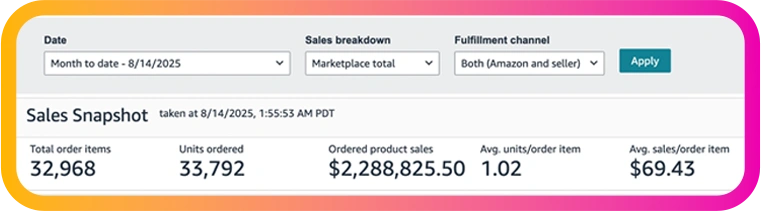
This is my highest-volume account. The Sales Snapshot was taken on August 14, 2025 at 1:55:53 AM PDT showing month-to-date performance — meaning $2,288,825.50 in ordered product sales in just the first 14 days of August 2025. Extrapolated across the full month, this account tracks toward over $4.5 million in August alone.
The average sales per order of $69.43 indicates this store operates in a mid-to-premium product range — the kind of category where margin per unit is strong enough to sustain the FBA fee structure and still return healthy net profit. At 12% net margin (conservative for this price point), this account generates roughly $274,000+ in net income on a full-month basis. The service team managing this account focuses heavily on catalog depth and advertising efficiency — both of which are reflected in the order velocity at this scale.
Account 2: $26,493.88 in Ordered Product Sales
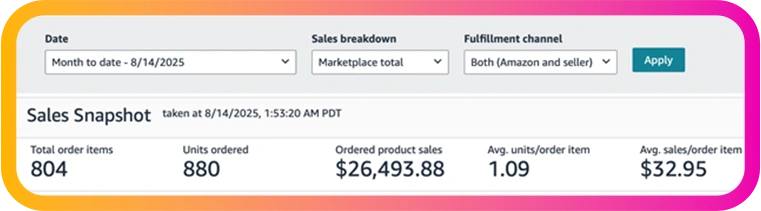
This account is at a different scale — $26,493.88 month-to-date through August 14 puts it on track for approximately $55,000-$58,000 for the full month. The average order value of $32.95 reflects a lower price-point category than Account 1, with higher order frequency relative to revenue. This is deliberate — lower-priced, high-velocity products build sales rank faster and accumulate reviews more quickly, which is a strategic advantage in the early growth phase of an account.
I include this account deliberately because it shows the realistic entry point. Not every managed Amazon store starts at seven-figure scale. This account is generating consistent five-figure monthly revenue with a catalog still in active growth mode. The pattern here — steady daily order flow with an upward revenue trend — is the signature of a properly managed account finding product-market fit in its category. For context, the Amazon SEO strategy behind these listings directly influences the order velocity you see in these numbers.
Account 3: $585,419.25 in Ordered Product Sales — Full July
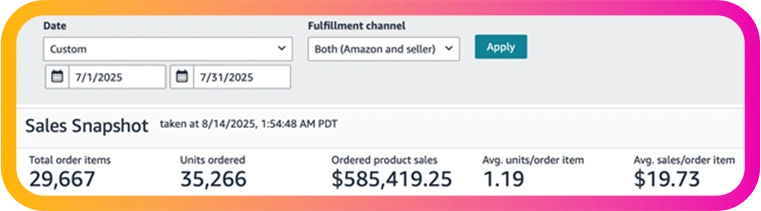
This account generated $585,419.25 in ordered product sales across all of July 2025 — 29,667 order items at an average of $19.73 per order. The average order value of $19.73 is notably lower than Account 1 or 2, but what stands out is the order volume: 29,667 order items in a single month means this store is processing roughly 957 order items per day. That order frequency is the hallmark of a high-velocity, everyday-use product category where Amazon's algorithm rewards consistent sell-through with strong organic ranking.
At 15% net margin on $585,419, this account generates approximately $87,813 in monthly net income. The service team's role in an account at this scale shifts from catalog building to catalog optimization — the focus becomes maintaining rank across a large SKU set, managing reorder timing to prevent stockouts at high velocity, and using Amazon repricer tools to hold the Buy Box efficiently across a competitive product landscape.
Account 4: $5,088,697.50 in Ordered Product Sales — Full July
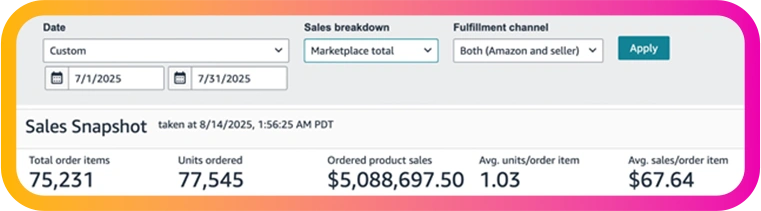
This is my flagship account. $5,088,697.50 in ordered product sales across July 2025 — 75,231 order items, 77,545 units ordered, averaging $67.64 per order. This account processes approximately 2,427 order items per day. At an average of $67.64 per order, the product mix skews toward higher-value items where the margin per unit is strong and the FBA fee is a smaller percentage of revenue.
What this account represents is what done-for-you Amazon store management looks like at full maturity: a deep catalog, consistent advertising spend managed by a specialist team, a supply chain that never goes out of stock on core SKUs, and an account health profile that Amazon's algorithm rewards with sustained search visibility. The service team operating this account runs it like a professional brand — because at $5M+ monthly revenue, that is exactly what it is. Understanding Amazon Brand Registry becomes critical at this scale; it unlocks additional protection and storefront tools that compound the account's competitive advantage.
5 Myths About Done-for-You Amazon Stores — Debunked
Most of the skepticism around done-for-you Amazon stores comes from either legitimate concerns about bad actors in the space or fundamental misunderstandings of how the model actually works. Here is what I believed before starting — and what the real experience showed.
"It is a passive investment — you give money and get guaranteed returns."
✓ RealityA done-for-you Amazon store is an operating business you own, managed by a service team you pay. Your capital buys inventory — a real asset in Amazon's warehouses under your account. Returns come from real customer purchases, not from any financial product. There are no guarantees, just like any business. The service provides operational expertise, not a return promise.
"You will see significant income within the first 30 days."
✓ RealityEvery one of my accounts took 60-90 days before consistent sales velocity appeared. The first month is account setup, product research, supplier sourcing, and FBA shipment processing. The second month is early traction as listings build rank. The third month is when velocity becomes predictable. Anyone promising meaningful income in Month 1 of a new Amazon account is misrepresenting the timeline.
"Amazon is too competitive — you cannot win against established sellers."
✓ RealityAmazon's marketplace grows every year and new product opportunities emerge continuously. Third-party sellers now account for 61-62% of all units sold on Amazon — the marketplace is built around external sellers. The competitive density varies by category and price point; a good service selects products specifically in categories where new entrants can compete effectively rather than listing in already saturated niches.
"The agency controls your account — you lose ownership."
✓ RealityA legitimate done-for-you service operates your account through authorized access — you own the Seller Central account, the inventory, and all revenue. Credentials are yours. Any agency claiming ownership of the account or refusing to confirm in writing that you retain full access is a red flag that should end the conversation immediately.
"All done-for-you Amazon services are the same."
✓ RealityThe gap between a good done-for-you service and a poor one is the difference between a $5M/month account and a store that never finds traction. Product selection methodology, FBA logistics competence, advertising expertise, and account health management vary enormously across providers. Verifiable client results — actual Seller Central data, not marketing graphics — and reviews on independent platforms (Trustpilot, Reviews.io) are the only reliable signals of real competence.
How Does a Done-for-You Amazon Store Service Work Day to Day?
From the client's perspective, a well-run done-for-you Amazon store runs almost entirely in the background. Here is the operational sequence from initial engagement through active management:
- Account setup (Week 1-2): Professional Seller Central configuration — business entity setup, tax documentation, bank account connection, brand registry preparation, and category ungating where needed. The service team also runs initial market analysis to identify product opportunities before sourcing begins.
- Product research and supplier sourcing (Week 2-5): The research team identifies products using real-time data: current sales rank, search volume, review velocity, competition density, and FBA margin analysis. Supplier relationships are established and vetted — price negotiation, quality control requirements, and delivery timelines confirmed before any inventory is committed.
- Listing creation and optimization (Week 4-6): Product listings are written and optimized specifically for Amazon's A9/A10 algorithm — including title structure, bullet point formatting, backend search terms, and A+ content where applicable. A well-optimized listing from day one is significantly easier to scale than retrofitting optimization after a product has gained rank history.
- FBA shipment to Amazon fulfillment centers (Week 5-8): Inventory is shipped to Amazon's network according to their inbound requirements. FBA-enrolled products receive Prime eligibility and Amazon's handling of picking, packing, shipping, and returns from the moment stock is received at the fulfillment center.
- Advertising launch and optimization (Ongoing from Week 6): Sponsored Products campaigns are built and launched concurrently with organic ranking efforts. The advertising team manages bids, keywords, campaign structure, and budget allocation — adjusting weekly based on performance data. For accounts at scale, I also leverage retail arbitrage research insights that the sourcing team feeds into product expansion decisions.
- Performance monitoring and catalog expansion (Ongoing): The service team monitors sales velocity, Buy Box win rate, inventory levels, and account health metrics daily. Reorders are placed proactively. New products are added as the catalog grows. I receive a structured performance report monthly and have direct access to my Seller Central account at all times.
Skip the Learning Curve — Have a Full Amazon Store Built and Managed for You
TechEcomm handles every layer — product research, FBA logistics, listing optimization, advertising, and ongoing management — while you own the account and keep the profits.
Why Does FBA Give Done-for-You Stores a Structural Advantage?
FBA (Fulfillment by Amazon) removes the single biggest operational burden in eCommerce — physical logistics — and hands it to the world's most sophisticated fulfillment infrastructure. For a done-for-you store model, this means the service team's operational effort concentrates on what actually drives revenue: product selection, listing quality, and advertising performance.
| Factor | Amazon FBA (Done-for-You) | Self-Managed FBM | Other Marketplaces |
|---|---|---|---|
| Fulfillment logistics | Amazon handles — 0 effort | Seller handles — daily work | Seller handles or 3PL cost |
| Prime eligibility | ✓ Automatic with FBA | ✗ Not available | Varies by platform |
| Buy Box priority | Strong FBA advantage | Disadvantaged vs FBA | Different algorithm |
| Returns handling | Amazon manages — 0 effort | Seller manages | Seller manages |
| Customer service | Amazon handles for FBA orders | Seller handles | Seller handles |
| Scale potential | Unlimited — no warehouse cap | Limited by seller capacity | Platform-dependent |
The table above explains why done-for-you services overwhelmingly focus on Amazon FBA rather than other fulfillment models. When logistics is handled by Amazon, the service team can dedicate 100% of its capacity to revenue-driving activities. When a seller is managing their own fulfillment (FBM), a significant portion of daily operational time goes to packing boxes rather than growing the business.
For sellers curious about how product selection works at the earliest stage — before any done-for-you service is involved — the guide on Amazon Merch on Demand shows one angle of Amazon's print-on-demand model, while selling used items on Amazon covers a different sourcing approach entirely. A full-service done-for-you provider applies a more sophisticated version of these sourcing principles at scale.
What Should You Look for in a Done-for-You Amazon Store Provider?
The provider you choose determines your store's trajectory more than any other single decision — including which products to sell. Here is the framework I used to evaluate agencies before choosing, and the questions I continue to ask quarterly.
Can They Show Real Seller Central Data — Not Just Marketing Graphics?
Real performance data looks like my screenshots above: a Seller Central interface with a date range, a Sales Snapshot header, and specific metric columns — Total order items, Units ordered, Ordered product sales, Avg. units/order item, Avg. sales/order item. A marketing graphic showing a revenue number without the Seller Central interface behind it is not equivalent. Ask for actual screen-captured Seller Central data before signing anything.
Are Their Reviews on Platforms They Don't Control?
Testimonials on a provider's own website are the weakest possible signal. Ask for their presence on Trustpilot, Reviews.io, or Google Business Profile — platforms where they cannot selectively delete negative reviews or fabricate volume. The number, recency, and content of independent reviews tells you more about an agency's actual client experience than any sales call.
What Is Their Product Research Methodology?
Ask specifically: "What data sources do you use for product selection, and what are your minimum thresholds for search volume, competition density, and estimated margin before you commit a product to a client's catalog?" A provider with a real process gives you a specific, data-grounded answer. A provider without one gives you a vague answer about "finding winning products."
How Do They Handle Account Health and Policy Compliance?
Amazon's policy enforcement has tightened significantly. A service team that has managed accounts at scale has encountered IP complaints, listing suppressions, and performance notifications — and should have clear documented processes for handling each. Ask what their account reinstatement rate is and how they approach preventative compliance. Building a storefront properly from the start using Amazon storefront best practices is one of the early compliance steps that separates well-run accounts from those that face repeated suppression issues.
What Happens If You Want to Leave?
Your Seller Central account is yours. A legitimate provider will confirm in writing that you have full access to the account at all times, that credentials are never held by the agency, and that you can take over the account or transfer it to another provider at any point. Any ambiguity on account access or data ownership is a significant red flag regardless of how good the sales pitch sounds.
Frequently Asked Questions
The Numbers Settle the Question
The four Seller Central screenshots in this post are not projections or estimates — they are snapshots of real accounts generating real revenue from real Amazon customers. $2,288,825.50 month-to-date. $26,493.88 month-to-date. $585,419.25 for July. $5,088,697.50 for July. These are what professionally managed done-for-you Amazon stores produce when the product research, listing quality, and operational management are handled by people who do this at scale every day.
The model works. The tradeoffs are real — 90-day ramp-up, genuine capital commitment, and complete dependence on the provider's operational competence. But when those factors are in place and the provider's track record is verifiable, a done-for-you Amazon store delivers exactly what it promises: a professionally managed Amazon business that generates income without requiring you to become an Amazon expert yourself.
If you are ready to start, TechEcomm's done-for-you Amazon store service handles every operational layer while you retain full account ownership. The results above speak to what that looks like in practice.
Ready to Own an Amazon Store That Generates Revenue Without Running It Yourself?
TechEcomm's done-for-you Amazon service handles sourcing, listings, FBA logistics, advertising, and everything in between — backed by verifiable client results. You own the account and keep the profits.

Amelia Johnson


Amelia Johnson is an E-Commerce Writer at TechEcomm with over 8 years of experience, working since 2018. She creates high-performing online content for small businesses and large enterprises across platforms like Amazon, Walmart, eBay, and Shopify. Amelia blends SEO strategy, marketplace expertise, and compelling storytelling to help brands grow, convert, and compete in fast-paced digital marketplaces.

Amelia Johnson
Amelia Johnson is an E-Commerce Writer at TechEcomm with over 8 years of experience, working since 2018. She creates high-performing online content for small businesses and large enterprises across platforms like Amazon, Walmart, eBay, and Shopify. Amelia blends SEO strategy, marketplace expertise, and compelling storytelling to help brands grow, convert, and compete in fast-paced digital marketplaces.